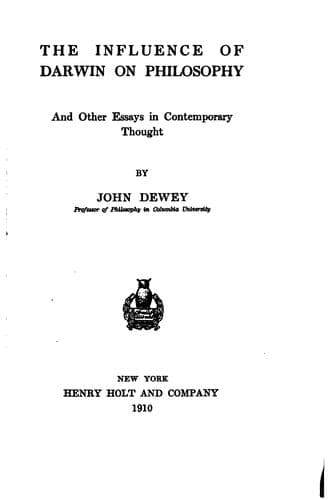
The Influence of Darwin on Philosophy, and other essays in contemporary thoughtDewey, John
Philosophy
The Influence of Darwin on Philosophy, and other essays in contemporary thought
Dewey, John
Evolution; Philosophy; Pragmatism
_Moore._ It is plain enough. You bid us turn to the cultivation, the
nurture, of certain values in human life. But the question is whether
these are or are not values. And that is a question of their relation
to the Universe--to Reality. If Reality substantiates them, then indeed
they are values; if it mocks and flouts them--as it surely does if what
mechanical science calls Nature be ultimate and absolute--then they are
_not_ values. You and your kind are really the sentimentalists, because
you are sheer subjectivists. You say: Accept the dream as real; do not
question about it; add a little iridescence to its fog and extend it
till it obscure even more of Reality than it naturally does, and all
is well! I say: Perhaps the dream is no dream but an intimation of the
solidest and most ultimate of all realities; and a thorough examination
of what the positivist, the materialist, accepts as solid, namely,
science, reveals as its own aim, standard, and presupposition that
Reality is one all-exhaustive spiritual Being.
_Eaton._ This is about the way I thought my begging of the question
would turn out. You insist upon translating my position into terms of
your own; I am not then surprised to hear that it would be a begging
of the question for _you_ to hold my views. My point is precisely
that it is only as long as you take the position that some Reality
beyond--some metaphysical or transcendental reality--is necessary to
substantiate empirical values that you can even discuss whether the
latter are genuine or illusions. Drop the presupposition that you read
into everything I say, the idea that the reality of things as they are
is dependent upon something beyond and behind, and the facts of the
case just stare you in the eyes: Goods _are_, a multitude of them--but,
unfortunately, evils also _are_; and all grades, pretty much, of both.
Not the contrast and relation of experience _in toto_ to something
beyond experience drives men to religion and then to philosophy; but
the contrast _within_ experience of the better and the worse, and the
consequent problem of how to substantiate the former and reduce the
latter. Until you set up the notion of a transcendental reality at
large, you cannot even raise the question of whether goods and evils
are, or only seem to be. The trouble and the joy, the good and the
evil, is _that_ they are; the hope is that they may be regulated,
guided, increased in one direction and minimized in another. Instead
of neglecting thought, we (I mean the pragmatists) exalt it, because
we say that intelligent discrimination of means and ends is the sole
final resource in this problem of all problems, the control of the
factors of good and ill in life. We say, indeed, not merely that that
is what intelligence _does_, but rather what it _is_.
Public-domain text, read in full here on John Shaqi.
Reviews
Reviews
No reviews yet
Be the first to share your thoughts on this work.
Join the Discussion
Join the discussion
Sign in to leave a comment or review.
Sign InorCreate an account