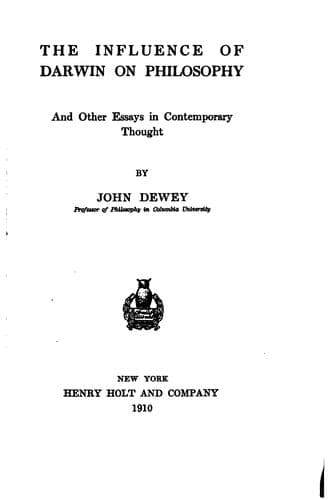
The Influence of Darwin on Philosophy, and other essays in contemporary thoughtDewey, John
Philosophy
The Influence of Darwin on Philosophy, and other essays in contemporary thought
Dewey, John
Evolution; Philosophy; Pragmatism
Historically, it is quite possible to show how under certain social
conditions this human and practical problem of the relation of good and
intelligence generated the notion of the transcendental good and the
pure reason. As Grimes reminded us, Plato----
_Moore._ Yes, and Protagoras--don’t forget him; for unfortunately we
know both the origin and the consequences of your doctrine that being
and seeming are the same. We know quite well that pure empiricism leads
to the identification of being and seeming, and that is just why every
deeply moral and religious soul from the time of Plato and Aristotle to
the present has insisted upon a transcendent reality.
_Eaton._ Personally I don’t need an absolute to enable me to
distinguish between, say, the good of kindness and the evil of slander,
or the good of health and the evil of valetudinarianism. In experience,
things bear their own specific characters. Nor has the absolute
idealist as yet answered the question of _how_ the absolute reality
enables him to distinguish between being and seeming in one single
concrete case. The trouble is that for him _all_ Being is on the other
side of experience, and _all_ experience is seeming.
_Grimes._ I think I heard you mention history. I wish both of you
would drop dialectics and go to history. You would find history to be
a struggle for existence--for bread, for a roof, for protected and
nourished offspring. You would find history a picture of the masses
always going under--just missing--in the struggle, because others have
captured the control of natural resources, which in themselves, if not
as benign as the eighteenth century imagined, are at least abundantly
ample for the needs of all. But because of the monopolization of Nature
by a few persons, most men and women only stick their heads above the
welter just enough to catch a glimpse of better things, then to be
shoved down and under. The only problem of the relation of Nature to
human good which is real is the economic problem of the exploitation
of natural resources in the equal interests of all, instead of in the
unequal interests of a class. The problem you two men are discussing
has no existence--and never had any--outside of the heads of a few
metaphysicians. The latter would never have amounted to anything,
would never have had any career at all, had not shrewd monopolists
or tyrants (with the skill that characterizes them) have seen that
these speculations about reality and a transcendental world could be
distilled into opiates and distributed among the masses to make them
less rebellious. That, if you would know, Eaton, is the real historic
origin of the ideal world beyond. When you realize that, you will
perceive that the pragmatists are only half-way over. You will see
that practical questions _are_ practical, and are not to be solved
merely by having a theory _about_ theory different from the traditional
one--which is all your pragmatism comes to.
Public-domain text, read in full here on John Shaqi.
Reviews
Reviews
No reviews yet
Be the first to share your thoughts on this work.
Join the Discussion
Join the discussion
Sign in to leave a comment or review.
Sign InorCreate an account