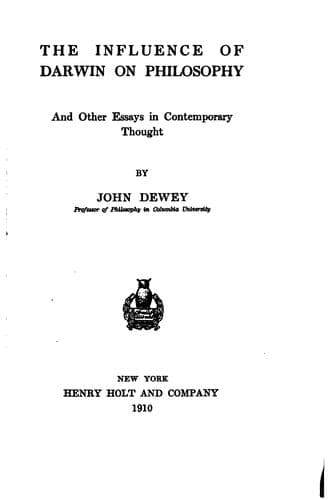
The Influence of Darwin on Philosophy, and other essays in contemporary thoughtDewey, John
Philosophy
The Influence of Darwin on Philosophy, and other essays in contemporary thought
Dewey, John
Evolution; Philosophy; Pragmatism
The view that purpose and realization are profoundly natural,
and that consciousness--or, if you will, experience--is itself a
culmination and climax of Nature, is not a new view. Formulated by
Aristotle, it has always persisted wherever the traditions of sound
thinking have not been obscured by romanticism. The modern scientific
doctrine of evolution confirms and specifies the metaphysical insight
of Aristotle. This doctrine sets forth in detail, and in verified
detail, as a genuine characteristic of existence, the tendency toward
cumulative results, the definite trend of things toward culmination and
achievement. It describes the universe as possessing, in terms of and
by right of its own subject-matter (not as an addition of subsequent
reflection), differences of value and importance--differences,
moreover, that exercise selective influence upon the course of things,
that is to say, genuinely determine the events that occur. It tells us
that consciousness itself is such a cumulative and culminating natural
event. Hence it is relevant to the world in which it dwells, and its
determinations of value are not arbitrary, not _obiter dicta_, but
descriptions of Nature herself.
Recall the words of Spencer which Moore quoted this morning: “There is
no pleasure in the consciousness of being an infinitesimal bubble on
a globe that is infinitesimal compared with the totality of things.
Those on whom the unpitying rush of changes inflicts sufferings which
are often without remedy, find no consolation in the thought that
they are at the mercy of blind forces,--which cause indifferently
now the destruction of a sun and now the death of an animalcule.
Contemplation of a universe which is without conceivable beginning or
end and without intelligible purpose, yields no satisfaction.” I am
naïve enough to believe that the only question is whether the object
of our “consciousness,” of our “thought,” of our “contemplation,”
is or is not as the quotation states it to be. If the statement be
correct, pragmatism, like subjectivism (of which I suspect it is
only a variation, putting emphasis upon will instead of idea), is an
invitation to close our eyes to what is, in order to encourage the
delusion that things are other than they are. But the case is not so
desperate. Speaking dogmatically, the account given of the universe
is just--not true. And the doctrine of evolution of which Spencer
professedly made so much is the evidence. A universe describable in
evolutionary terms is a universe which shows, not indeed design, but
tendency and purpose; which exhibits achievement, not indeed of a
single end, but of a multiplicity of natural goods at whose apex is
consciousness. No account of the universe in terms _merely_ of the
redistribution of matter in motion is complete, no matter how true as
far as it goes, for it ignores the cardinal fact that the character
of matter in motion and of its redistribution is such as cumulatively
Public-domain text, read in full here on John Shaqi.
Reviews
Reviews
No reviews yet
Be the first to share your thoughts on this work.
Join the Discussion
Join the discussion
Sign in to leave a comment or review.
Sign InorCreate an account