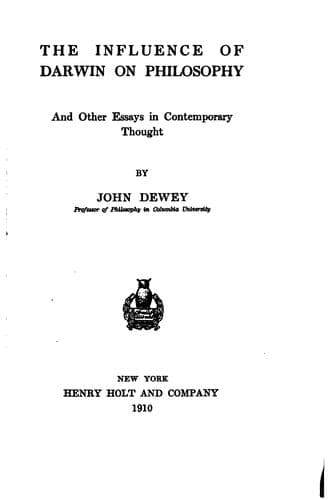
The Influence of Darwin on Philosophy, and other essays in contemporary thoughtDewey, John
Philosophy
The Influence of Darwin on Philosophy, and other essays in contemporary thought
Dewey, John
Evolution; Philosophy; Pragmatism
_Moore._ If you mean that your own crass Philistinism is all that
pragmatism comes to, I fancy you are about right. Forget that the
only end of action is to bring about an approximation to the complete
inclusive consciousness; make, as the pragmatists do, consciousness
a means to action, and one form of external activity is just as
good as another. Art, religion, all the generous reaches of science
which do not show up immediately in the factory--these things become
meaningless, and all that remains is that hard and dry satisfaction of
economic wants which is Grimes’s ideal.
_Grimes._ An ideal which exists, by the way, only in your imagination.
I know of no more convincing proof of the futile irrelevancy of
idealism than the damning way in which it narrows the content of actual
daily life in the minds of those who uphold idealism. I sometimes think
I am the only true idealist. If the conditions of an equitable and
ample physical existence for all were once secured, I, for one, have
no fears as to the bloom and harvest of art and science, and all the
“higher” things of leisure. Life is interesting enough for me; give it
a show for all.
_Arthur._ I find myself in a peculiar position in respect to this
discussion. An analysis of what is involved in this peculiarity may
throw some light on the points at issue, for I have to believe that
analysis and definition of what exists is the essential matter both
in resolution of doubts and in steps at reform. For brevity, not from
conceit, I will put the peculiarity to which I refer in a personal
form. I do not believe for a moment in some different Reality beyond
and behind Nature. I do not believe that a manipulation of the logical
implications of science can give results which are to be put in the
place of those which Science herself yields in her direct application.
I accept Nature as something which is, not seems, and Science as her
faithful transcript. Yet because I believe these things, not in spite
of them, I believe in the existence of purpose and of good. How Eaton
can believe that fulfilment and the increasing realization of purpose
can exist in human consciousness unless they first exist in the world
which is revealed in that consciousness is as much beyond me as how
Moore can believe that a manipulation of the method of knowledge can
yield considerations of a totally different order from those directly
obtained by use of the method. If purpose and fulfilment exist as
natural goods, then, and only then, can consciousness itself be a
fulfilment of Nature, and be also a natural good. Any other view is
inexplicable to sound thinking--save, historically, as a product of
modern political individualism and literary romanticism which have
combined to produce that idealistic philosophy according to which the
mind in knowing the universe creates it.
Public-domain text, read in full here on John Shaqi.
Reviews
Reviews
No reviews yet
Be the first to share your thoughts on this work.
Join the Discussion
Join the discussion
Sign in to leave a comment or review.
Sign InorCreate an account