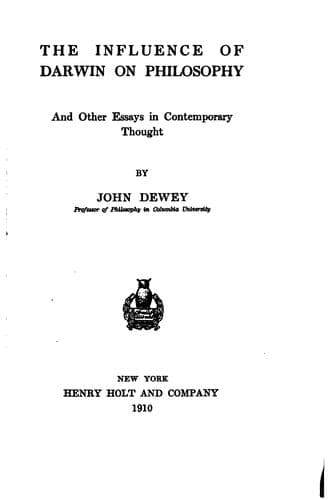
The Influence of Darwin on Philosophy, and other essays in contemporary thought — John Shaqi
The Influence of Darwin on Philosophy, and other essays in contemporary thoughtDewey, John
Philosophy
The Influence of Darwin on Philosophy, and other essays in contemporary thought
Dewey, John
Evolution; Philosophy; Pragmatism
_Moore._ To get back into the game which Grimes despises. Doesn’t
Arthur practically say that the universe is good because it culminates
in intelligence, and that intelligence is good because it perceives
that the universe culminates in--itself? And, on this theory, are
ignorance and error, and consequent evil, any less genuine achievements
of Nature than intelligence and good? And on what basis does he
call by the titles of achievement and end that which at best is an
infinitesimally fragmentary and transitory episode? I said Eaton
begged the question. Arthur seems to regard it as proof of a superior
intelligence (one which realistically takes things as they are) to beg
the question. What is this Nature, this universe in which evil is as
stubborn a fact as good, in which good is constantly destroyed by the
very power that produces it, in which there resides a temporary bird of
passage--consciousness doomed to ultimate extinction--what is such a
Nature (all that Arthur offers us) save the problem, the contradiction
originally in question? A complacent optimism may gloss over its
intrinsic self-contradictions, but a more serious mind is forced to go
behind and beyond this scene to a permanent good which includes and
transcends goods defeated and hopes suborned. Not because idealists
have refused to note the facts as they are, but precisely because
Nature is, on its face, such a scene as Arthur describes, idealists
have always held that it is but Appearance, and have attempted to mount
through it to Reality.
_Stair._ I had not thought to say anything. My attitude is so different
from that of any one of you that it seemed unnecessary to inject
another varying opinion where already disagreement reigns. But when
Arthur was speaking, I felt that perhaps this disagreement exists
precisely because the solvent word had not been uttered. For, at
bottom, all of you agree with Arthur, and that is the cause of your
disagreement with him and one another. You have agreed to make reason,
intellect in some sense, the final umpire. But reason, intellect, is
the principle of analysis, of division, of discord. When I appeal
to feeling as the ultimate organ of unity, and hence of truth, you
smile courteously; say--or think--mysticism; and the case for you is
dismissed. Words like feeling, sensation, immediate appreciation,
self-communication of Being, I must indeed use when I try to tell
the truth I see. But I well know how inadequate the words are. And
why? Because language is the chosen tool of intelligence, and hence
inevitably bewrayeth the truth it would convey. But remember that words
are but symbols, and that intelligence must dwell in the realm of
symbols, and you realize a way out. These words, sensation, feeling,
etc., as I utter them are but invitations to woo you to put yourselves
into the one attitude that reveals truth--an attitude of direct vision.
Public-domain text, read in full here on John Shaqi.
Reviews
Reviews
No reviews yet
Be the first to share your thoughts on this work.
Join the Discussion
Join the discussion
Sign in to leave a comment or review.
Sign InorCreate an account