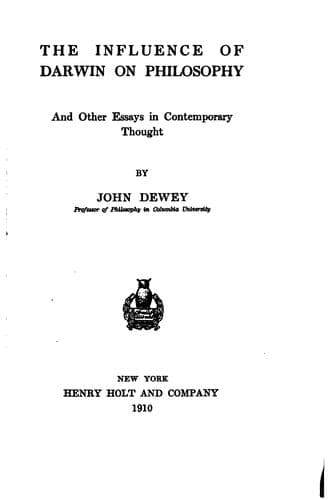
The Influence of Darwin on Philosophy, and other essays in contemporary thought — John Shaqi
The Influence of Darwin on Philosophy, and other essays in contemporary thoughtDewey, John
Philosophy
The Influence of Darwin on Philosophy, and other essays in contemporary thought
Dewey, John
Evolution; Philosophy; Pragmatism
What, finally, is this Nature to which the philosophy of society and
the individual so bound itself? It is the nature which figures in
Greek customs and myth; the nature resplendent and adorned which
confronts us in Greek poetry and art: the animism of savage man purged
of grossness and generalized by unerring esthetic taste into beauty
and system. The myths had told of the loves and hates, the caprices
and desertions of the gods, and behind them all, inevitable Fate.
Philosophy translated these tales into formulæ of the brute fluctuation
of rapacious change held in bounds by the final and supreme end: the
rational good. The animism of the popular mind died to reappear as
cosmology.
Repeatedly in this course we have heard of sciences which began as
parts of philosophy and which gradually won their independence. Another
statement of the same history is that both science and philosophy began
in subjection to mythological animism. Both began with acceptance of
a nature whose irregularities displayed the meaningless variability
of foolish wants held within the limits of order and uniformity by an
underlying movement toward a final and stable purpose. And when the
sciences gradually assumed the task of reducing irregular caprice to
regular conjunction, philosophy bravely took upon itself the task of
substantiating, under the caption of a spiritual view of the universe,
the animistic survival. Doubtless Socrates brought philosophy to earth;
but his injunction to man to know himself was incredibly compromised
in its execution by the fact that later philosophers submerged man in
the world to which philosophy was brought: a world which was the heavy
and sunken center of hierarchic heavens located in their purity and
refinement as remotely as possible from the gross and muddy vesture of
earth.
Public-domain text, read in full here on John Shaqi.
Reviews
Reviews
No reviews yet
Be the first to share your thoughts on this work.
Join the Discussion
Join the discussion
Sign in to leave a comment or review.
Sign InorCreate an account