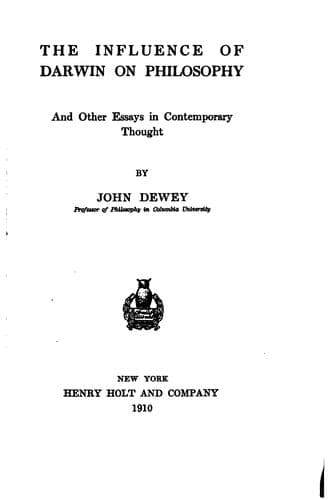
The Influence of Darwin on Philosophy, and other essays in contemporary thoughtDewey, John
Philosophy
The Influence of Darwin on Philosophy, and other essays in contemporary thought
Dewey, John
Evolution; Philosophy; Pragmatism
There is likewise a profound saying of Aristotle’s that the individual
who otherwise than by accident is not a member of a state is either a
brute or a god. But it is generally forgotten that elsewhere Aristotle
identified the highest excellence, the chief virtue, with pure thought,
and identifying this with the divine, isolated it in lonely grandeur
from the life of society. That man, so far as in him lay, should be
godlike, meant that he should be non-social, because supra-civic.
Plato the idealist had shared the belief that reason is the divine;
but he was also a reformer and a radical and he would have those who
attained rational insight descend again into the civic cave, and in
its obscurity labor patiently for the enlightenment of its blear-eyed
inhabitants. Aristotle, the conservative and the definer of what is,
gloried in the exaltation of intelligence in man above civic excellence
and social need; and thereby isolated the life of truest knowledge
from contact with social experience and from responsibility for
discrimination of values in the course of life.
Moral theory, however, accepted from social custom more than its
cataleptic rigidity, its exclusive area of common good, and its
unfructified and irresponsible reason. The city-state was a superficial
layer of cultured citizens, cultured through a participation in affairs
made possible by relief from economic pursuits, superimposed upon
the dense mass of serfs, artizans, and laborers. For this division,
moral philosophy made itself spiritual sponsor, and thus took it up
into its own being. Plato wrestled valiantly with the class problem;
but his outcome was the necessity of decisive demarcation, after
education, of the masses in whom reason was asleep and appetite much
awake, from the few who were fit to rule because alertly wise. The most
generously imaginative soul of all philosophy could not far outrun the
institutional practices of his people and his times. This might have
warned his successors of the danger of deserting the sober path of a
critical discernment of the better and the worse within contemporary
life for the more exciting adventure of a final determination of
absolute good and evil. It might have taught the probability that some
brute residuum or unrationalized social habit would be erected into an
apotheosis of pure reason. But the lesson was not learned. Aristotle
promptly yielded to the besetting sin of all philosophers, the
idealization of the existent: he declared that the class distinctions
of superiority and inferiority as between man and woman, master and
slave, liberal-minded and base mechanic, exist and are justified by
nature--a nature which aims at embodied reason.
Public-domain text, read in full here on John Shaqi.
Reviews
Reviews
No reviews yet
Be the first to share your thoughts on this work.
Join the Discussion
Join the discussion
Sign in to leave a comment or review.
Sign InorCreate an account