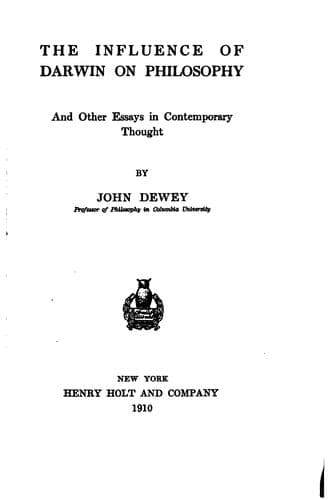
The Influence of Darwin on Philosophy, and other essays in contemporary thoughtDewey, John
Philosophy
The Influence of Darwin on Philosophy, and other essays in contemporary thought
Dewey, John
Evolution; Philosophy; Pragmatism
The growth of industry and commerce is at once cause and effect of
the growth in science. Democritus and other ancients conceived the
mechanical theory of the universe. The notion was not only blank and
repellent, because it ignored the rich social material which Plato and
Aristotle had organized into their rival idealistic views; but it was
scientifically sterile, a piece of dialectics. Contempt for machines as
the accouterments of despised mechanics kept the mechanical conception
aloof from these specific and controllable experiences which alone
could fructify it. This conception, then, like the idealistic, was
translated into a speculative cosmology and thrown like a vast net
around the universe at large, as if to keep it from coming to pieces.
It is from respect for the lever, the pulley, and the screw that modern
experimental and mathematical mechanics derives itself. Motion, traced
through the workings of a machine, was followed out into natural
events and studied just as motion, not as a poor yet necessary device
for realizing final causes. So studied, it was found to be available
for new machines and new applications, which in creating new ends
also promoted new wants, and thereby stimulated new activities, new
discoveries, and new inventions. The recognition that natural energy
can be systematically applied, through experimental observation, to
the satisfaction and multiplication of concrete wants is doubtless the
greatest single discovery ever imported into the life of man--save
perhaps the discovery of language. Science, borrowing from industry,
repaid the debt with interest, and has made the control of natural
forces for the aims of life so inevitable that for the first time
man is relieved from overhanging fear, with its wolflike scramble to
possess and accumulate, and is freed to consider the more gracious
question of securing to all an ample and liberal life. The industrial
life had been condemned by Greek exaltation of abstract thought and by
Greek contempt for labor, as representing the brute struggle of carnal
appetite for its own satiety. The industrial movement, offspring of
science, restored it to its central position in morals. When Adam Smith
made economic activity the moving spring of man’s unremitting effort,
from the cradle to the grave, to better his own lot, he recorded this
change. And when he made sympathy the central spring in man’s conscious
moral endeavor, he reported the effect which the increasing intercourse
of men, due primarily to commerce, had in breaking down suspicion and
jealousy and in liberating man’s kindlier impulses.
Public-domain text, read in full here on John Shaqi.
Reviews
Reviews
No reviews yet
Be the first to share your thoughts on this work.
Join the Discussion
Join the discussion
Sign in to leave a comment or review.
Sign InorCreate an account