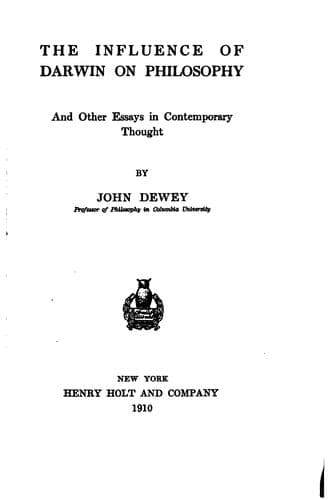
The Influence of Darwin on Philosophy, and other essays in contemporary thought — John Shaqi
The Influence of Darwin on Philosophy, and other essays in contemporary thoughtDewey, John
Philosophy
The Influence of Darwin on Philosophy, and other essays in contemporary thought
Dewey, John
Evolution; Philosophy; Pragmatism
Democracy, the crucial expression of modern life, is not so much an
addition to the scientific and industrial tendencies as it is the
perception of their social or spiritual meaning. Democracy is an
absurdity where faith in the individual as individual is impossible;
and this faith is impossible when intelligence is regarded as a cosmic
power, not an adjustment and application of individual tendencies.
It is also impossible when appetites and desires are conceived to be
the dominant factor in the constitution of most men’s characters, and
when appetite and desire are conceived to be manifestations of the
disorderly and unruly principle of nature. To put the intellectual
center of gravity in the objective cosmos, outside of men’s own
experiments and tests, and then to invite the application of individual
intelligence to the determination of society, is to invite chaos.
To hold that want is mere negative flux and hence requires external
fixation by reason, and then to invite the wants to give free play to
themselves in social construction and intercourse, is to call down
anarchy. Democracy is estimable only through the changed conception of
intelligence, that forms modern science, and of want, that forms modern
industry. It is essentially a changed psychology. The substitution, for
_a priori_ truth and deduction, of fluent doubt and inquiry meant trust
in human nature in the concrete; in individual honesty, curiosity,
and sympathy. The substitution of moving commerce for fixed custom
meant a view of wants as the dynamics of social progress, not as the
pathology of private greed. The nineteenth century indeed turned sour
on that somewhat complacent optimism in which the eighteenth century
rested: the ideas that the intelligent self-love of individuals would
conduce to social cohesion, and competition among individuals usher in
the kingdom of social welfare. But the conception of a social harmony
of interests in which the achievement by each individual of his own
freedom should contribute to a like perfecting of the powers of all,
through a fraternally organized society, is the permanent contribution
of the industrial movement to morals--even though so far it be but the
contribution of a problem.
Public-domain text, read in full here on John Shaqi.
Reviews
Reviews
No reviews yet
Be the first to share your thoughts on this work.
Join the Discussion
Join the discussion
Sign in to leave a comment or review.
Sign InorCreate an account