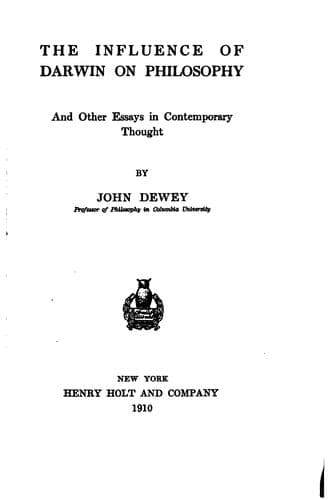
The Influence of Darwin on Philosophy, and other essays in contemporary thought — John Shaqi
The Influence of Darwin on Philosophy, and other essays in contemporary thoughtDewey, John
Philosophy
The Influence of Darwin on Philosophy, and other essays in contemporary thought
Dewey, John
Evolution; Philosophy; Pragmatism
Tremendously effective as a tool of criticism, operative in
abolition and elimination, utilitarianism failed to measure up to
the constructive needs of the time. Its theoretical equalization of
the good of each with that of every other was practically perverted
by its excessive interest in the middle and manufacturing classes.
Its speculative defect of an atomistic psychology combined with this
narrowness of vision to make light of the constructive work that
needs to be done by the state, before all can have, otherwise than in
name, an equal chance to count in the common good. Thus the age-long
subordination of economics to politics was revenged in the submerging
of both politics and ethics in a narrow theory of economic profit; and
utilitarianism, in its orthodox descendants, proffered the disjointed
pieces of a mechanism, with a monotonous reiteration that looked at
aright they form a beautifully harmonious organism.
Prevision, and to some extent experience, of this failure, conjoined
with differing social traditions and ambitions, evoked German idealism,
the transcendental morals of Kant and his successors. German thought
strove to preserve the traditions which bound culture to the past,
while revising these traditions to render them capable of meeting
novel conditions. It found weapons at hand in the conceptions borrowed
by Roman law from Stoic philosophy, and in the conceptions by which
Protestant humanism had re-edited scholastic Catholicism. Grotius had
made the idea of natural law, natural right and obligation, the central
idea of German morals, as thoroughly as Locke had made the individual
desire for liberty and happiness the focus of English and then of
French speculation. Materialized idealism is the happy monstrosity in
which the popular demand for vivid imagery is most easily reconciled
with the equally strong demand for supremacy of moral values; and the
complete idealistic materialism of Stoicism has always given its ideas
a practical influence out of all proportion to their theoretical vogue
as a system. To the Protestant, that is the German, humanist, Natural
Law, the bond of harmonious reason in nature, the spring of social
intercourse among men, the inward light of individual conscience,
united Cicero, St. Paul, and Luther in blessed union; gave a rational,
not superrational basis for morals, and provided room for social
legislation which at the same time could easily be held back from too
ruthless application to dominant class interests.
Public-domain text, read in full here on John Shaqi.
Reviews
Reviews
No reviews yet
Be the first to share your thoughts on this work.
Join the Discussion
Join the discussion
Sign in to leave a comment or review.
Sign InorCreate an account