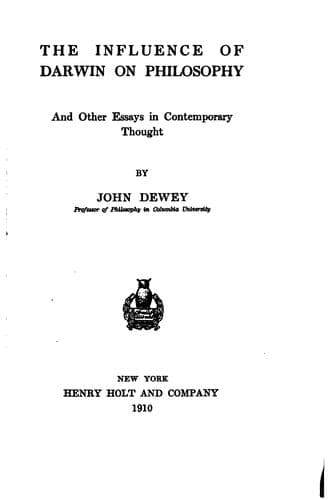
The Influence of Darwin on Philosophy, and other essays in contemporary thought — John Shaqi
The Influence of Darwin on Philosophy, and other essays in contemporary thoughtDewey, John
Philosophy
The Influence of Darwin on Philosophy, and other essays in contemporary thought
Dewey, John
Evolution; Philosophy; Pragmatism
Kant saw the mass of empirical and hence irrelevant detail that had
found refuge within this liberal and diffusive reason. He saw that the
idea of reason could be made self-consistent only by stripping it naked
of these empirical accretions. He then provided, in his critiques, a
somewhat cumbrous moving van for transferring the resultant pure or
naked reason out of nature and the objective world, and for locating
it in new quarters, with a new stock of goods and new customers. The
new quarters were particular subjects, individuals; the stock of goods
were the forms of perception and the functions of thought by which
empirical flux is woven into durable fabrics; the new customers were a
society of individuals in which all are ends in themselves. There ought
to be an injunction issued that Kant’s saying about Hume’s awakening of
him should not be quoted save in connection with his other saying that
Rousseau brought him to himself, in teaching him that the philosopher
is of less account than the laborer in the fields unless he contributes
to human freedom. But none the less, the new tenant, the universal
reason, and the old homestead, the empirical tumultuous individual,
could not get on together. Reason became a mere voice which, having
nothing in particular to say, said Law, Duty, in general, leaving to
the existing social order of the Prussia of Frederick the Great the
congenial task of declaring just what was obligatory in the concrete.
The marriage of freedom and authority was thus celebrated with the
understanding that sentimental primacy went to the former and practical
control to the latter.
The effort to force a universal reason that had been used to the broad
domains of the cosmos into the cramped confines of individuality
conceived as merely “empirical,” a highly particularized creature of
sense, could have but one result: an explosion. The products of that
explosion constitute the Post-Kantian philosophies. It was the work of
Hegel to attempt to fill in the empty reason of Kant with the concrete
contents of history. The voice sounded like the voice of Aristotle,
Thomas of Aquino, and Spinoza translated into Swabian German; but the
hands were as the hands of Montesquieu, Herder, Condorcet, and the
rising historical school. The outcome was the assertion that history
is reason, and reason is history: the actual is rational, the rational
is the actual. It gave the pleasant appearance (which Hegel did not
strenuously discourage) of being specifically an idealization of the
Prussian nation, and incidentally a systematized apologetic for the
universe at large. But in intellectual and practical effect, it lifted
the idea of process above that of fixed origins and fixed ends, and
presented the social and moral order, as well as the intellectual, as a
scene of becoming, and it located reason somewhere within the struggles
of life.
Public-domain text, read in full here on John Shaqi.
Reviews
Reviews
No reviews yet
Be the first to share your thoughts on this work.
Join the Discussion
Join the discussion
Sign in to leave a comment or review.
Sign InorCreate an account