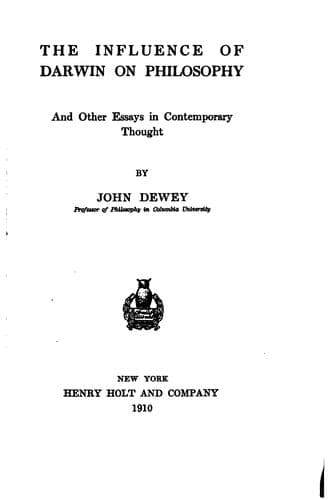
The Influence of Darwin on Philosophy, and other essays in contemporary thoughtDewey, John
Philosophy
The Influence of Darwin on Philosophy, and other essays in contemporary thought
Dewey, John
Evolution; Philosophy; Pragmatism
The transformation in attitude, to which I referred, is the growing
belief that the proper business of intelligence is discrimination
of multiple and present goods and of the varied immediate means of
their realization; not search for the one remote aim. The progress of
biology has accustomed our minds to the notion that intelligence is not
an outside power presiding supremely but statically over the desires
and efforts of man, but is a method of adjustment of capacities and
conditions within specific situations. History, as the lecturer on
that subject told us, has discovered itself in the idea of process.
The genetic standpoint makes us aware that the systems of the past are
neither fraudulent impostures nor absolute revelations; but are the
products of political, economic, and scientific conditions whose change
carries with it change of theoretical formulations. The recognition
that intelligence is properly an organ of adjustment in difficult
situations makes us aware that past theories were of value so far as
they helped carry to an issue the social perplexities from which they
emerged. But the chief impact of the evolutionary method is upon the
present. Theory having learned what it cannot do, is made responsible
for the better performance of what needs to be done, and what only a
broadly equipped intelligence can undertake: study of the conditions
out of which come the obstacles and the resources of adequate life,
and developing and testing the ideas that, as working hypotheses, may
be used to diminish the causes of evil and to buttress and expand the
sources of good. This program is indeed vague, but only unfamiliarity
with it could lead one to the conclusion that it is less vague than the
idea that there is a single moral ideal and a single moral motive force.
From this point of view there is no separate body of moral rules; no
separate system of motive powers; no separate subject-matter of moral
knowledge, and hence no such thing as an isolated ethical science.
If the business of morals is not to speculate upon man’s final end
and upon an ultimate standard of right, it is to utilize physiology,
anthropology, and psychology to discover all that can be discovered of
man, his organic powers and propensities. If its business is not to
search for the one separate moral motive, it is to converge all the
instrumentalities of the social arts, of law, education, economics,
and political science upon the construction of intelligent methods of
improving the common lot.
If we still wish to make our peace with the past, and to sum up the
plural and changing goods of life in a single word, doubtless the term
happiness is the one most apt. But we should again exchange free morals
for sterile metaphysics, if we imagine that “happiness” is any less
unique than the individuals who experience it; any less complex than
the constitution of their capacities, or any less variable than the
objects upon which their capacities are directed.
Public-domain text, read in full here on John Shaqi.
Reviews
Reviews
No reviews yet
Be the first to share your thoughts on this work.
Join the Discussion
Join the discussion
Sign in to leave a comment or review.
Sign InorCreate an account