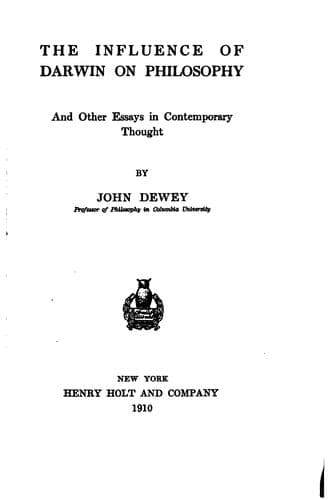
The Influence of Darwin on Philosophy, and other essays in contemporary thoughtDewey, John
Philosophy
The Influence of Darwin on Philosophy, and other essays in contemporary thought
Dewey, John
Evolution; Philosophy; Pragmatism
To many timid, albeit sincere, souls of an earlier century, the decay
of the doctrine that all true and worthful science is knowledge of
final causes seemed fraught with danger to science and to morals. The
rival conception of a wide open universe, a universe without bounds in
time or space, without final limits of origin or destiny, a universe
with the lid off, was a menace. We now face in moral science a similar
crisis and like opportunity, as well as share in a like dreadful
suspense. The abolition of a fixed and final goal and causal force in
nature did not, as matter of fact, render rational conviction less
important or less attainable. It was accompanied by the provision of
a technique of persistent and detailed inquiry in all special fields
of fact, a technique which led to the detection of unsuspected forces
and the revelation of undreamed of uses. In like fashion we may
anticipate that the abolition of _the_ final goal and _the_ single
motive power and _the_ separate and infallible faculty in morals, will
quicken inquiry into the diversity of specific goods of experience, fix
attention upon their conditions, and bring to light values now dim and
obscure. The change may relieve men from responsibility for what they
cannot do, but it will promote thoughtful consideration of what they
may do and the definition of responsibility for what they do amiss
because of failure to think straight and carefully. Absolute goods
will fall into the background, but the question of making more sure
and extensive the share of all men in natural and social goods will be
urgent, a problem not to be escaped nor evaded.
Morals, philosophy, returns to its first love; love of the wisdom that
is nurse, as nature is mother, of good. But it returns to the Socratic
principle equipped with a multitude of special methods of inquiry and
testing; with an organized mass of knowledge, and with control of the
arrangements by which industry, law, and education may concentrate upon
the problem of the participation by all men and women, up to their
capacity of absorption, in all attained values. Morals may then well
leave to poetry and to art, the task (so unartistically performed by
philosophy since Plato) of gathering together and rounding out, into
one abiding picture, the separate and special goods of life. It may
leave this task with the assurance that the resultant synthesis will
not depict any final and all-inclusive good, but will add just one more
specific good to the enjoyable excellencies of life.
Public-domain text, read in full here on John Shaqi.
Reviews
Reviews
No reviews yet
Be the first to share your thoughts on this work.
Join the Discussion
Join the discussion
Sign in to leave a comment or review.
Sign InorCreate an account