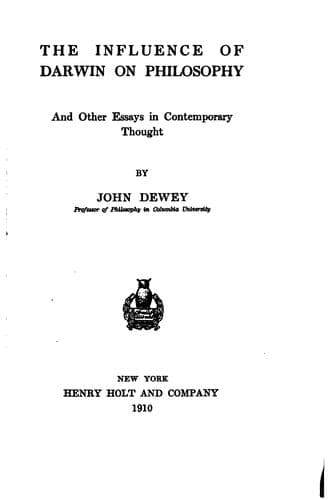
The Influence of Darwin on Philosophy, and other essays in contemporary thoughtDewey, John
Philosophy
The Influence of Darwin on Philosophy, and other essays in contemporary thought
Dewey, John
Evolution; Philosophy; Pragmatism
There are, indeed, but two alternative courses. We must either find the
appropriate objects and organs of knowledge in the mutual interactions
of changing things; or else, to escape the infection of change, we
_must_ seek them in some transcendent and supernal region. The human
mind, deliberately as it were, exhausted the logic of the changeless,
the final, and the transcendent, before it essayed adventure on the
pathless wastes of generation and transformation. We dispose all too
easily of the efforts of the schoolmen to interpret nature and mind in
terms of real essences, hidden forms, and occult faculties, forgetful
of the seriousness and dignity of the ideas that lay behind. We dispose
of them by laughing at the famous gentleman who accounted for the
fact that opium put people to sleep on the ground it had a dormitive
faculty. But the doctrine, held in our own day, that knowledge of the
plant that yields the poppy consists in referring the peculiarities
of an individual to a type, to a universal form, a doctrine so firmly
established that any other method of knowing was conceived to be
unphilosophical and unscientific, is a survival of precisely the same
logic. This identity of conception in the scholastic and anti-Darwinian
theory may well suggest greater sympathy for what has become unfamiliar
as well as greater humility regarding the further unfamiliarities that
history has in store.
Darwin was not, of course, the first to question the classic philosophy
of nature and of knowledge. The beginnings of the revolution are in
the physical science of the sixteenth and seventeenth centuries.
When Galileo said: “It is my opinion that the earth is very noble
and admirable by reason of so many and so different alterations and
generations which are incessantly made therein,” he expressed the
changed temper that was coming over the world; the transfer of interest
from the permanent to the changing. When Descartes said: “The nature
of physical things is much more easily conceived when they are beheld
coming gradually into existence, than when they are only considered as
produced at once in a finished and perfect state,” the modern world
became self-conscious of the logic that was henceforth to control
it, the logic of which Darwin’s “Origin of Species” is the latest
scientific achievement. Without the methods of Copernicus, Kepler,
Galileo, and their successors in astronomy, physics, and chemistry,
Darwin would have been helpless in the organic sciences. But prior
to Darwin the impact of the new scientific method upon life, mind,
and politics, had been arrested, because between these ideal or moral
interests and the inorganic world intervened the kingdom of plants and
animals. The gates of the garden of life were barred to the new ideas;
and only through this garden was there access to mind and politics. The
influence of Darwin upon philosophy resides in his having conquered the
phenomena of life for the principle of transition, and thereby freed
Public-domain text, read in full here on John Shaqi.
Reviews
Reviews
No reviews yet
Be the first to share your thoughts on this work.
Join the Discussion
Join the discussion
Sign in to leave a comment or review.
Sign InorCreate an account