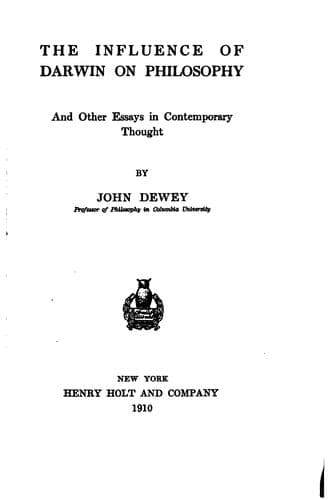
The Influence of Darwin on Philosophy, and other essays in contemporary thought — John Shaqi
The Influence of Darwin on Philosophy, and other essays in contemporary thoughtDewey, John
Philosophy
The Influence of Darwin on Philosophy, and other essays in contemporary thought
Dewey, John
Evolution; Philosophy; Pragmatism
the new logic for application to mind and morals and life. When he said
of species what Galileo had said of the earth, _e pur si muove_, he
emancipated, once for all, genetic and experimental ideas as an organon
of asking questions and looking for explanations.
III
The exact bearings upon philosophy of the new logical outlook are, of
course, as yet, uncertain and inchoate. We live in the twilight of
intellectual transition. One must add the rashness of the prophet to
the stubbornness of the partizan to venture a systematic exposition of
the influence upon philosophy of the Darwinian method. At best, we can
but inquire as to its general bearing--the effect upon mental temper
and complexion, upon that body of half-conscious, half-instinctive
intellectual aversions and preferences which determine, after all, our
more deliberate intellectual enterprises. In this vague inquiry there
happens to exist as a kind of touchstone a problem of long historic
currency that has also been much discussed in Darwinian literature.
I refer to the old problem of design _versus_ chance, mind _versus_
matter, as the causal explanation, first or final, of things.
As we have already seen, the classic notion of species carried with it
the idea of purpose. In all living forms, a specific type is present
directing the earlier stages of growth to the realization of its own
perfection. Since this purposive regulative principle is not visible
to the senses, it follows that it must be an ideal or rational force.
Since, however, the perfect form is gradually approximated through the
sensible changes, it also follows that in and through a sensible realm
a rational ideal force is working out its own ultimate manifestation.
These inferences were extended to nature: (_a_) She does nothing in
vain; but all for an ulterior purpose. (_b_) Within natural sensible
events there is therefore contained a spiritual causal force, which
as spiritual escapes perception, but is apprehended by an enlightened
reason. (_c_) The manifestation of this principle brings about a
subordination of matter and sense to its own realization, and this
ultimate fulfilment is the goal of nature and of man. The design
argument thus operated in two directions. Purposefulness accounted for
the intelligibility of nature and the possibility of science, while
the absolute or cosmic character of this purposefulness gave sanction
and worth to the moral and religious endeavors of man. Science was
underpinned and morals authorized by one and the same principle, and
their mutual agreement was eternally guaranteed.
Public-domain text, read in full here on John Shaqi.
Reviews
Reviews
No reviews yet
Be the first to share your thoughts on this work.
Join the Discussion
Join the discussion
Sign in to leave a comment or review.
Sign InorCreate an account