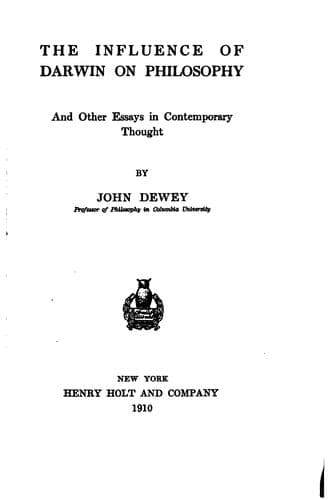
The Influence of Darwin on Philosophy, and other essays in contemporary thoughtDewey, John
Philosophy
The Influence of Darwin on Philosophy, and other essays in contemporary thought
Dewey, John
Evolution; Philosophy; Pragmatism
If we face the bogie thus called up, it will be found that the horror
is largely sentimental. Suppose we stick to the notion that truth is a
character which belongs to a meaning so far as tested through action
that carries it to successful completion. In this case, to make an idea
true is to modify and transform it until it reaches this successful
outcome: until it initiates a mode of response which in its issue
realizes its claim to be the method of harmonizing the discrepancies of
a given situation. The meaning is remade by constantly acting upon it,
and by introducing into its content such characters as are indicated
by any resulting failures to secure harmony. From this point of view,
verification and truth are two names for the same thing. We call it
“verification” when we regard it as process; when the development of
the idea is strung out and exposed to view in all that makes it true.
We call it “truth” when we take it as product, as process telescoped
and condensed.
Suppose the idea to be an invention, say of the telephone. In this
case, is not the verification of the idea and the construction of
the device which carries out its intent one and the same? In this
case, does the truth of the idea mean anything else than that the
issue proves the idea can be carried into effect? There are certain
intellectualists who are not of the absolutist type; who do not believe
that all of men’s aims, designs, projects, that have to do with action,
whether industrial, social, or moral in scope, have been from all
eternity registered as already accomplished in reality. How do such
persons dispose of this problem of the truth of practical ideas?
Is not the truth of _such_ ideas an affair of _making_ them true by
constructing, through appropriate behavior, a condition that satisfies
the requirements of the case? If, in this case, truth means the
effective capacity of the idea “to make good,” what is there in the
logic of the case to forbid the application of analogous considerations
to any idea?
Public-domain text, read in full here on John Shaqi.
Reviews
Reviews
No reviews yet
Be the first to share your thoughts on this work.
Elsewhere in the archive
Join the Discussion
Join the discussion
Sign in to leave a comment or review.
Sign InorCreate an account