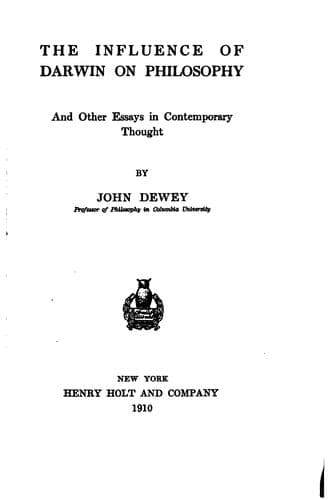
The Influence of Darwin on Philosophy, and other essays in contemporary thoughtDewey, John
Philosophy
The Influence of Darwin on Philosophy, and other essays in contemporary thought
Dewey, John
Evolution; Philosophy; Pragmatism
So much for some of the more obvious facts of the discussion of design
_versus_ chance, as causal principles of nature and of life as a whole.
We brought up this discussion, you recall, as a crucial instance. What
does our touchstone indicate as to the bearing of Darwinian ideas
upon philosophy? In the first place, the new logic outlaws, flanks,
dismisses--what you will--one type of problems and substitutes for
it another type. Philosophy forswears inquiry after absolute origins
and absolute finalities in order to explore specific values and the
specific conditions that generate them.
Darwin concluded that the impossibility of assigning the world to
chance as a whole and to design in its parts indicated the insolubility
of the question. Two radically different reasons, however, may be
given as to why a problem is insoluble. One reason is that the problem
is too high for intelligence; the other is that the question in its
very asking makes assumptions that render the question meaningless.
The latter alternative is unerringly pointed to in the celebrated
case of design _versus_ chance. Once admit that the sole verifiable
or fruitful object of knowledge is the particular set of changes that
generate the object of study together with the consequences that then
flow from it, and no intelligible question can be asked about what,
by assumption, lies outside. To assert--as is often asserted--that
specific values of particular truth, social bonds and forms of beauty,
if they can be shown to be generated by concretely knowable conditions,
are meaningless and in vain; to assert that they are justified only
when they and their particular causes and effects have all at once been
gathered up into some inclusive first cause and some exhaustive final
goal, is intellectual atavism. Such argumentation is reversion to the
logic that explained the extinction of fire by water through the formal
essence of aqueousness and the quenching of thirst by water through the
final cause of aqueousness. Whether used in the case of the special
event or that of life as a whole, such logic only abstracts some
aspect of the existing course of events in order to reduplicate it as
a petrified eternal principle by which to explain the very changes of
which it is the formalization.
Public-domain text, read in full here on John Shaqi.
Reviews
Reviews
No reviews yet
Be the first to share your thoughts on this work.
Join the Discussion
Join the discussion
Sign in to leave a comment or review.
Sign InorCreate an account