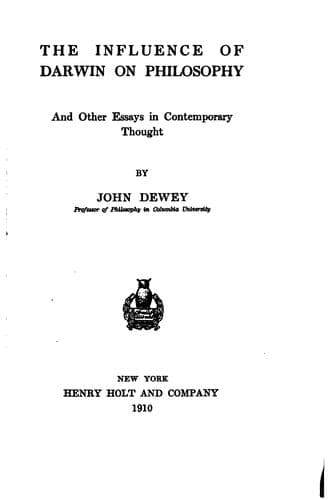
The Influence of Darwin on Philosophy, and other essays in contemporary thought — John Shaqi
The Influence of Darwin on Philosophy, and other essays in contemporary thoughtDewey, John
Philosophy
The Influence of Darwin on Philosophy, and other essays in contemporary thought
Dewey, John
Evolution; Philosophy; Pragmatism
When Henry Sidgwick casually remarked in a letter that as he grew older
his interest in what or who made the world was altered into interest in
what kind of a world it is anyway, his voicing of a common experience
of our own day illustrates also the nature of that intellectual
transformation effected by the Darwinian logic. Interest shifts from
the wholesale essence back of special changes to the question of
how special changes serve and defeat concrete purposes; shifts from
an intelligence that shaped things once for all to the particular
intelligences which things are even now shaping; shifts from an
ultimate goal of good to the direct increments of justice and happiness
that intelligent administration of existent conditions may beget and
that present carelessness or stupidity will destroy or forego.
In the second place, the classic type of logic inevitably set
philosophy upon proving that life _must_ have certain qualities and
values--no matter how experience presents the matter--because of some
remote cause and eventual goal. The duty of wholesale justification
inevitably accompanies all thinking that makes the meaning of special
occurrences depend upon something that once and for all lies behind
them. The habit of derogating from present meanings and uses prevents
our looking the facts of experience in the face; it prevents serious
acknowledgment of the evils they present and serious concern with the
goods they promise but do not as yet fulfil. It turns thought to the
business of finding a wholesale transcendent remedy for the one and
guarantee for the other. One is reminded of the way many moralists and
theologians greeted Herbert Spencer’s recognition of an unknowable
energy from which welled up the phenomenal physical processes without
and the conscious operations within. Merely because Spencer labeled his
unknowable energy “God,” this faded piece of metaphysical goods was
greeted as an important and grateful concession to the reality of the
spiritual realm. Were it not for the deep hold of the habit of seeking
justification for ideal values in the remote and transcendent, surely
this reference of them to an unknowable absolute would be despised in
comparison with the demonstrations of experience that knowable energies
are daily generating about us precious values.
Public-domain text, read in full here on John Shaqi.
Reviews
Reviews
No reviews yet
Be the first to share your thoughts on this work.
Join the Discussion
Join the discussion
Sign in to leave a comment or review.
Sign InorCreate an account