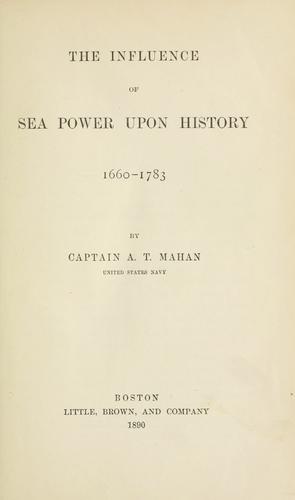
The Influence of Sea Power Upon History, 1660-1783Mahan, A. T. (Alfred Thayer)
History
The Influence of Sea Power Upon History, 1660-1783
Mahan, A. T. (Alfred Thayer)
Naval history, Modern; Sea-power
As regards the condition of France in 1660, and her readiness to move
onward in the road marked by Richelieu, it may be said that internal
peace was secured, the power of the nobles wholly broken, religious
discords at rest; the tolerant edict of Nantes was still in force,
while the remaining Protestant discontent had been put down by the
armed hand. All power was absolutely centred in the throne. In other
respects, though the kingdom was at peace, the condition was less
satisfactory. There was practically no navy; commerce, internal and
external, was not prosperous; the finances were in disorder; the army
small.
Spain, the nation before which all others had trembled less than a
century before, was now long in decay and scarcely formidable; the
central weakness had spread to all parts of the administration. In
extent of territory, however, she was still great. The Spanish
Netherlands still belonged to her; she held Naples, Sicily, and
Sardinia; Gibraltar had not yet fallen into English hands; her vast
possessions in America--with the exception of Jamaica, conquered by
England a few years before--were still untouched. The condition of her
sea power, both for peace and war, has been already alluded to. Many
years before, Richelieu had contracted a temporary alliance with
Spain, by virtue of which she placed forty ships at his disposal; but
the bad condition of the vessels, for the most part ill armed and ill
commanded, compelled their withdrawal. The navy of Spain was then in
full decay, and its weakness did not escape the piercing eye of the
cardinal. An encounter which took place between the Spanish and Dutch
fleets in 1639 shows most plainly the state of degradation into which
this once proud navy had fallen.
Public-domain text, read in full here on John Shaqi.
Reviews
Reviews
No reviews yet
Be the first to share your thoughts on this work.
Elsewhere in the archive
Join the Discussion
Join the discussion
Sign in to leave a comment or review.
Sign InorCreate an account