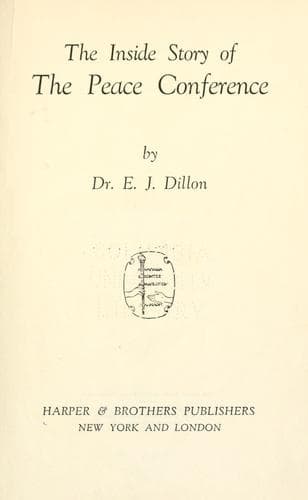
The Inside Story of the Peace ConferenceDillon, Emile Joseph
History
The Inside Story of the Peace Conference
Dillon, Emile Joseph
Paris Peace Conference (1919-1920)
One of the serious worries of the Conference chiefs in their dealings
with Russia was the lack of a recognized government there, qualified to
sign receipts for advances of money and munitions. And as they could not
resolve to accord recognition to any of the existing administrations,
they hit upon the middle course, that of promoting the anti-Bolshevists
to the rank of a community, not, indeed, sovereign or independent, but
deserving of every kind of assistance except the despatch of Allied
troops. Assistance was already being given liberally, but the necessity
was felt for justifying it formally. And the two delegates went to work
as though they were hatching some dark and criminal plot. Secretly
despatching a message to Admiral Kolchak, they put a number of questions
to him which he was not qualified to answer without first consulting his
official advisers in Paris. Yet these advisers were not apprised by the
Secret Council of what was being done. Nay, more, the French Foreign
Office was not notified. By the merest chance I got wind of the matter
and published the official message.[271] It summoned the Admiral to bind
himself to convene a Constituent Assembly as soon as he arrived in
Moscow; to hold free elections; to repudiate definitely the old régime
and all that it implied; to recognize the independence of Poland and
Finland, whose frontiers would be determined by the League of Nations;
to avail himself of the advice and co-operation of the League in coming
to an understanding with the border states, and to acquiesce in the
decision of the Peace Conference respecting the future status of
Bessarabia. Kolchak's answer was described as clear when "decipherable,"
and to his credit, he frankly declined to forestall the will of the
Constituent Assembly respecting those border states which owed their
separate existence to the initiative of the victorious governments. But
the Secret Council of the Conference accepted his answer, and relied
upon it as an adequate reason for continuing the assistance which they
had been giving him theretofore.
Public-domain text, read in full here on John Shaqi.
Reviews
Reviews
No reviews yet
Be the first to share your thoughts on this work.
Elsewhere in the archive
Join the Discussion
Join the discussion
Sign in to leave a comment or review.
Sign InorCreate an account