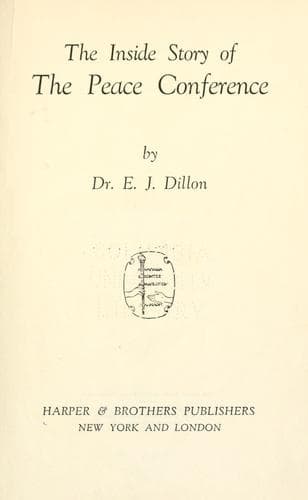
The Inside Story of the Peace ConferenceDillon, Emile Joseph
History
The Inside Story of the Peace Conference
Dillon, Emile Joseph
Paris Peace Conference (1919-1920)
About the person of Kolchak it ought to be superfluous to say more than
that he is an upright citizen of energy and resolution, as patriotic as
Fabricius, as disinterested and unambitious as Cincinnatus. To his
credit account, which is considerable, stands his wonder-working faith
in the recuperative forces of his country when its fortunes were at
their lowest ebb. With buoyancy and confidence he set himself the task
of rescuing his fellow-countrymen when it looked as hopeless as that of
Xenophon at Cunaxa. He created an army out of nothing, induced his men
by argument, suasion, and example to shake off the virus of indiscipline
and sacrifice their individual judgment and will to the well-being of
their fellows. He enjoined nothing upon others that he himself was not
ready to undertake, and he exposed himself time and again to risks
greater far than any general should deliberately incur. Whether he
succeeds or fails in his arduous enterprise, Kolchak, by his preterhuman
patience and sustained energy and courage, has deserved exceptionally
well of his country, and could afford to ignore the current legends that
depict him in the crying colors of a reactionary, even though they were
accepted for the time by the most exalted among the Great Unversed in
Russian affairs. One may dissent from his policy and object to some of
his lieutenants and to many of his partizans, but from the
single-minded, patriotic soldier one cannot withhold a large meed of
praise. Kolchak's defects are mostly exaggerations of his qualities. His
remarkable versatility is purchased at the price of fitfulness, his
energy displays itself in spurts, and his impulsiveness impairs at times
the successful execution of a plan which requires unflagging constancy.
His judgment of men is sometimes at fault, but he would never hesitate
to confer a high post upon any man who deserved it. He is democratic in
the current sense of the word, but neither a doctrinaire nor a faddist.
A disciplinarian and a magnetic personality withal, he charms as
effectually as he commands his soldiers. He is enlightened enough, like
the great Western world-menders in their moments of theorizing, to
discountenance secrecy and hole-and-corner agreements, and, what is
still more praiseworthy, he is courageous enough to practise the
doctrine.
Public-domain text, read in full here on John Shaqi.
Reviews
Reviews
No reviews yet
Be the first to share your thoughts on this work.
Elsewhere in the archive
Join the Discussion
Join the discussion
Sign in to leave a comment or review.
Sign InorCreate an account