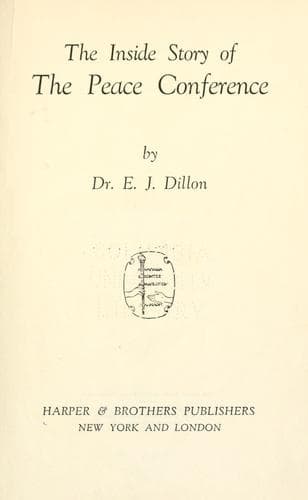
The Inside Story of the Peace ConferenceDillon, Emile Joseph
History
The Inside Story of the Peace Conference
Dillon, Emile Joseph
Paris Peace Conference (1919-1920)
The plenipotentiaries, during the first four months, approached
Bolshevism from a single direction, unvaried by the events which it
generated or the modifications which it underwent. They tested it solely
by its accidental bearings on the one aim which they were intent on
securing--a formal and provisional resettlement of Europe capable of
being presented to their respective parliaments as a fair achievement.
With its real character, its manifold corollaries, its innovating
tendencies over the social, political, and ethnical domain, they were
for the time being unconcerned. Without the slightest reference to any
of these considerations they were ready to find a place for it in the
new state system with which they hoped to endow the world. More than
once they were on the point of giving it official recognition. There was
no preliminary testing, sifting, or examining by these empiricists, who,
finding Bolshevism on their way, and discerning no facile means of
dislodging or transforming it, signified their willingness under easy
conditions to hallmark and incorporate it as one of the elements of the
new ordering. From the crimes laid to its charge they were prepared to
make abstraction. The barbarous methods to which it owed its very
existence they were willing to consign to oblivion. And it was only a
freak of circumstance that hindered this embodiment of despotism from
beginning one of their accepted means of rendering the world safe for
democracy.
Political students outside the Conference, going farther into the
matter, inquired whether there was any kernel of truth in the doctrines
of Lenin, any social or political advantage in the practices of
Braunstein (Trotzky), and the conclusions which they reached were
negative.[277] But inquiries of this theoretical nature awakened no
interest among the empiricists of the Supreme Council. For them
Bolshevism meant nothing more than a group of politicians, who directed,
or misdirected, but certainly represented the bulk of the Russian
people, and who, if won over and gathered under the cloak of the
Conference, would facilitate its task and bear witness to its triumph.
This inference, drawn by keen observers from many countries and parties,
is borne out by the curious admissions and abortive acts of the
principal plenipotentiaries themselves.
Public-domain text, read in full here on John Shaqi.
Reviews
Reviews
No reviews yet
Be the first to share your thoughts on this work.
Elsewhere in the archive
Join the Discussion
Join the discussion
Sign in to leave a comment or review.
Sign InorCreate an account