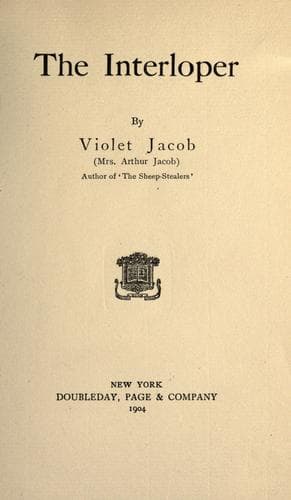
Scotland -- Social life and customs -- 19th century -- Fiction
Cecilia was one of those unusual people whose outward personalities
never look unsuitable to the life encompassing them, though their
inward beings may be completely aloof from everything surrounding them
physically. She sat down by the table, her gray gown melting into the
background of the walls, and the whiteness of her long neck rising
distinct from it. Her dress was cut open in front and bordered by a
narrow line of brown fur which crossed on her bosom. Though she was so
slim, the little emerald brooch which held the fastening of it together
sank into the hollow made by her figure; her hair was drawn up on the
top of her head, and piled in many rolls round a high, tortoiseshell
comb. Her long eyes, under straight brows, seemed, in expression, to be
holding something hidden behind the eyelashes, something intangible,
elusive. To see her was to be reminded, consciously or unconsciously,
of mists, of shadows, of moonlit things--things half seen, things
remembered. Her lips closed evenly, though in beautiful lines, and the
upper, not short enough for real beauty, had an outward curve, as it
rested on its fellow, which held a curious attraction. She was very
pale with a pallor that did not suggest ill-health.
Though she was the only young inhabitant of Morphie, she existed among
the dusty passages--dusty with the powdering of ages--and the sober
unconventionality of the place as naturally as one of those white
plants which haunt remote waterways exists among the hidden hollows and
shadows of pools. She was very distantly related to Lady Eliza Lamont,
but, when the death of both parents had thrown her on the world, a
half-grown, penniless girl, she had come to Morphie for a month to gain
strength after an illness, and remained there twelve years. Lady Eliza,
ostentatiously grumbling at the responsibility she had imposed upon
herself, found, at the end of the time, that she could not face the
notion of parting with Cecilia. It was the anxiety of her life that,
though she had practically adopted the girl, she had nothing she could
legally leave her at her death but her own personal possessions.
Public-domain text, read in full here on John Shaqi.
Reviews
Reviews
No reviews yet
Be the first to share your thoughts on this work.
Join the Discussion
Join the discussion
Sign in to leave a comment or review.
Sign InorCreate an account