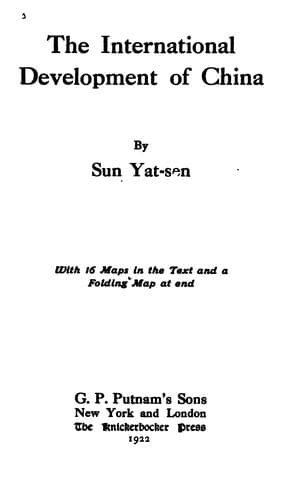
The International Development of ChinaSun, Yat-sen
History
The International Development of China
Sun, Yat-sen
China -- Economic conditions -- 1912-1949; Railroads -- China
I have intentionally left out the first principle--"the most
remunerative field must be selected"--not because I want to neglect
it but because I mean to call more attention to it and treat it more
fully. It is commonly known to financiers and railway men that a
railway in a densely populated country from end to end is the best
paying proposition, and a railway in a thinly settled country from end
to end is the least paying one. And a railway in an almost unpopulated
country like our projected lines will take a long time to make it a
paying business. That is why the United States Government had to grant
large tracts of public lands to railway corporations to induce them to
build the Transcontinental lines to the Pacific Coast, half a century
ago. Whenever I talked with foreign railway men and financiers about
the construction of railways to Mongolia and Sinkiang, they generally
got very shy of the proposition. Undoubtedly they thought that it
is for political and military reasons only that such a line as the
Siberian Railway was built, which traversed through a thinly populated
land. But they could not grasp the fact which might be entirely new
to them, that a railway between a densely populated country and a
sparsely settled country will pay far better than one that runs
from end to end in a densely populated land. The reason is that in
economic conditions the two ends of a well populated country are not
so different as that between a thickly populated country and a newly
opened country. At the two ends of a well populated country, in many
respects, the local people are self-supplying, excepting a few special
articles which they depend upon the other end of the road to supply.
So the demand and supply between the two places are not very great,
thus the trade between the two ends of the railway could not be very
lucrative. While the difference of the economic condition between a
well populated country and an unpopulated country is very great. The
workers of the new land have to depend upon the supplies of the thickly
populated country almost in everything excepting foodstuffs and raw
materials which they have in abundance and for disposal of which they
have to depend upon the demand of the well populated district. Thus the
trade between the two ends of the line will be extraordinarily great.
Furthermore, a railway in a thickly populated place will not affect
much the masses which consist of the majority of the population. It
is only the few well-to-do and the merchants and tradesmen that make
use of it. While with a railway between a thickly populated country
and a sparsely settled or unsettled country, as soon as it is opened
to traffic for each mile, the masses of the congested country will use
it and rush into the new land in a wholesale manner. Thus the railway
will be employed to its utmost capacity in passenger traffic from the
beginning. The comparison between the Peking-Hankow Railway and the
Public-domain text, read in full here on John Shaqi.
Reviews
Reviews
No reviews yet
Be the first to share your thoughts on this work.
Join the Discussion
Join the discussion
Sign in to leave a comment or review.
Sign InorCreate an account