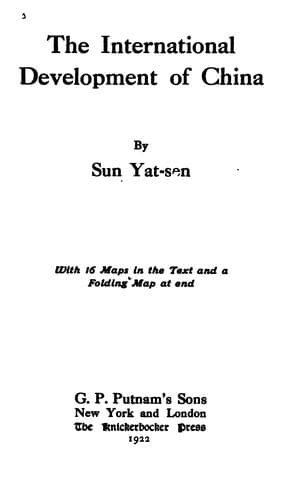
The International Development of ChinaSun, Yat-sen
History
The International Development of China
Sun, Yat-sen
China -- Economic conditions -- 1912-1949; Railroads -- China
Peking-Mukden Railway in China is a convincing proof.
The Peking-Hankow Railway is a line of over eight hundred miles running
from the capital of the country to the commercial center in the heart
of China right along in an extraordinarily densely settled country
from end to end. While the Peking-Mukden line is barely six hundred
miles in length running from a thickly populated country to thinly
populated Manchuria. The former is a well paying line but the latter
pays far better. The net profit of the shorter Peking-Mukden Line is
sometimes three to four millions more yearly than that of the longer
Peking-Hankow line.
Therefore, it is logically clear that a railway in a thickly populated
country is much better than one that is in a thinly populated country
in remuneration. But a railway between a very thickly populated and
a very thinly populated or unpopulated country is the best paying
proposition. This is a law in Railway Economics which hitherto had not
been discovered by railway men and financiers.
According to this new railway economic law, our projected railway
will be the best remunerative project of its kind. For at the one
end, we have our projected port which acts as a connecting link with
the thickly populated coast of China and the Yangtze Valley and also
the two existing lines, the Kingham and the Tsinpu, as feeders to the
projected port and the Dolon Nor line. And at the other end, we have
a vast and rich territory, larger than China Proper, to be developed.
There is no such vast fertile field so near to a center of a population
of four hundred millions to be found in any other part of the world.
PART III
The Colonization of Mongolia and Sinkiang
The Colonization of Mongolia and Sinkiang is a complement of the
Railway scheme. Each is dependent upon the other for its prosperity.
The colonization scheme, besides benefitting the railway, is in itself
a greatly profitable undertaking. The results of the United States,
Canada, Australia, and Argentina are ample proofs of this. In the
case of our project, it is simply a matter of applying waste Chinese
labor and foreign machinery to a fertile land for production for which
its remuneration is sure. The present Colonization of Manchuria,
notwithstanding its topsy turvy way which caused great waste of land
and human energy, has been wonderfully prosperous. If we would adopt
scientific methods in our colonization project we could certainly
obtain better results than all the others. Therefore, I propose
that the whole movement be directed in a systematic way by state
organization with the help of foreign experts and war organizers, for
the good of the colonists particularly and the nation generally.
Public-domain text, read in full here on John Shaqi.
Reviews
Reviews
No reviews yet
Be the first to share your thoughts on this work.
Join the Discussion
Join the discussion
Sign in to leave a comment or review.
Sign InorCreate an account