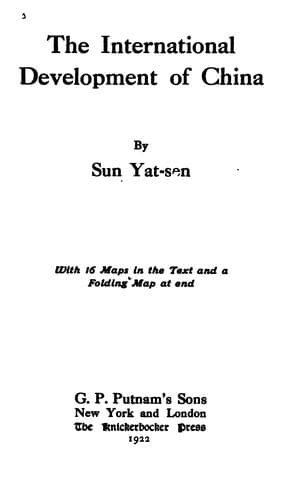
The International Development of ChinaSun, Yat-sen
History
The International Development of China
Sun, Yat-sen
China -- Economic conditions -- 1912-1949; Railroads -- China
With a profit of $30,000,000 in the course of twenty years before
us, it is a worth-while proposition to take up. Now let us see what
amount of capital should be invested before the whole project of our
reclamation work could be completed. In order to reclaim this 450
square miles of land two hundred miles of embankments have to be built.
Part of these projected embankments will be along the shore line, a
greater part will be in midstream, and a small part in deep channel.
Those along the shore line need not be bothered with except that the
concave surface must be protected with stone or concrete work. Those
in midstream should be filled up with stone ten feet or less below
low-water level just enough to give a resistance to the undercurrent in
order to prevent it from running sideward. Thus the main current would
follow the line of least resistance and cut the channel, as directed by
the rudimental embankment, by its own force. This rudimental embankment
would cost less than the sea wall which I estimated at $200,000 per
mile. Except at one point, that is, the junction of the North Channel
at Mason Point, which has to be blocked up entirely, the cost for
which, as has been estimated by experts, would amount to over a million
dollars for a distance of two or three miles. Thus the profits accruing
from the reclaimed lands would be quite sufficient to pay for the
embankments. So far we see that the regulating of the Yangtze from the
sea to Kiangyin is a self-paying proposition from the reclamation of
land alone, aside from the improvement of the navigation of the Yangtze
River.
c. From Kiangyin to Wuhu
This part of the river is quite different in nature from that below
Kiangyin. Its channel is more stable and only in a few places sharp
curves occur and the water has cut into the concave sides of the land,
thus occasionally making new channels along the sides of the two
shores. This section of the river is about 180 miles in length. See Map
VII.
Public-domain text, read in full here on John Shaqi.
Reviews
Reviews
No reviews yet
Be the first to share your thoughts on this work.
Join the Discussion
Join the discussion
Sign in to leave a comment or review.
Sign InorCreate an account