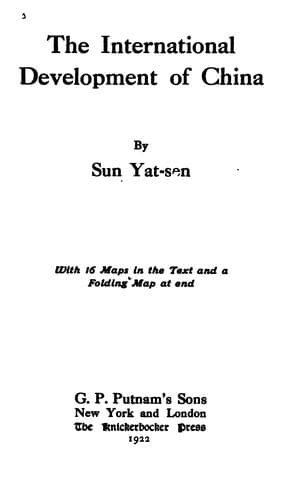
The International Development of ChinaSun, Yat-sen
History
The International Development of China
Sun, Yat-sen
China -- Economic conditions -- 1912-1949; Railroads -- China
deep, two fifths of that sum should be quite sufficient to finance
the work that I have projected. While writing this, I came across an
article in the _Chicago Railway Review_, May 17, 1919, dealing with the
same subject, which states that steel skeleton is a better and cheaper
substitute for stone or other materials for building dikes and jetties
in a muddy river like ours. Thus, by this new method, we may be able
to construct embankments, with cheaper material than I have hitherto
known. So, although the estimate which I have made may be somewhat low,
yet it is not so far from correct as it seems at first sight.
PART III
The Construction of River Ports
The construction of river ports along the Yangtze between Hankow and
the sea will be one of the most remunerative propositions in our
development scheme. For this part of the Yangtze Valley is richest
in agricultural and mineral products in China and is very densely
populated. With the cheap water transportation provided by the
completion of the regulating work both sides of this water highway
will surely become industrial beehives. And with cheap labor near by,
it will not be a surprise if in the near future both banks will become
two continuous cities, as it were, right along the whole extent of the
river from Hankow to the sea. In the meantime a few suitable spots
should be chosen for profitable city development. For this purpose I
will start from the lower part of the river as follows:
a. Chinkiang and North Side.
b. Nanking and Pukow.
c. Wuhu.
d. Anking and South Side.
e. Poyang Port.
f. Wuhan.
a. Chinkiang and North Side
Chinkiang is situated at the junction of the Grand Canal and the
Yangtze. It was an important center of inland water traffic between the
north and the south before the steam age. But it will resume its former
grandeur and become more important when the old inland waterway is
improved, and new ones are constructed. For it is the gateway between
the Hoangho and Yangtze valleys. Besides, by the southern portion of
the Grand Canal, Chinkiang is connected with the Tsientang valley--the
richest part of China. Thus, this city is bound to grow into a great
commercial center in the near future.
Public-domain text, read in full here on John Shaqi.
Reviews
Reviews
No reviews yet
Be the first to share your thoughts on this work.
Join the Discussion
Join the discussion
Sign in to leave a comment or review.
Sign InorCreate an account