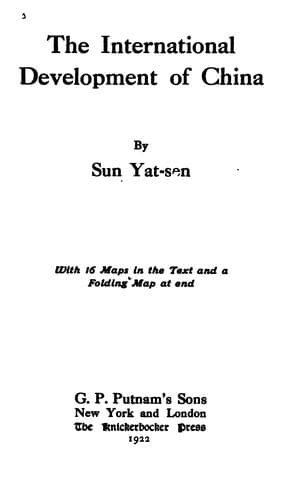
The International Development of ChinaSun, Yat-sen
History
The International Development of China
Sun, Yat-sen
China -- Economic conditions -- 1912-1949; Railroads -- China
This is the sixth line from the railway center. It also starts on the
northern side of the Nonni-Sungari junction, and proceeds across the
plain by the cities Chaotung and Tsingkang. After Tsingkang it crosses
the Tungkun River, proceeds to Hailun, and then, ascending the Tungkun
Valley, crosses the watershed of the Little Khingan Mountain. Thence it
descends into the Korfen Valley and proceeds by Chelu to Korfen on the
right bank of the Amur River. This line covers a distance of 350 miles,
two thirds of which run on comparatively level land and one third in
mountainous district. This is the shortest line from Tungchin to the
Amur River and the Russian territory on yonder side.
g. The Tungchin-Yaoho Line
This is the seventh line that radiates from this railway center.
It starts from the northern side of the Nonni-Sungari junction and
traverses the plain on the left of the Sungari River by Chaochow, then
crosses the Chinese Eastern Railway, and the Hulan River to Hulan.
After Hulan, it proceeds to Payen, Mulan, and Tungho, then crosses the
Sungari River to Sansing, now called Ilan. Thence it proceeds into the
Wokan Valley and crosses the watershed by Chihsingshitse and Takokai
into the Noloho Valley and passing by various villages and towns along
this river to Yaohohsien, ends at the junction of the Noloho and the
Ussuri River. This line covers a distance of 500 miles in very fertile
country.
h. The Tungchin-Yenchi Line
This is the eighth line that radiates from this railway center. It
starts from the eastern side of the Nonni-Sungari junction and proceeds
in a southeasterly direction on the right side of the Sungari River to
Fuyu or Petunai and various towns along the road on the same side of
the river until it comes across the Harbin-Talien Railway, then turns
away from the road and proceeds eastward to Yushu and Wuchang. After
Wuchang, the line turning more southward, proceeds to Fengtechang and
then follows the same direction to Omu. At Omu, it crosses the Mutan
River, then proceeds to Liangshuichuan and Shehtauho, where it joins
the Japanese Hweining-Kirin line and proceeds together to Yenchi. This
line covers a length of about 330 miles through very rich agricultural
and mineral country.
i. The Tungchin-Changpeh Line
Public-domain text, read in full here on John Shaqi.
Reviews
Reviews
No reviews yet
Be the first to share your thoughts on this work.
Elsewhere in the archive
Join the Discussion
Join the discussion
Sign in to leave a comment or review.
Sign InorCreate an account