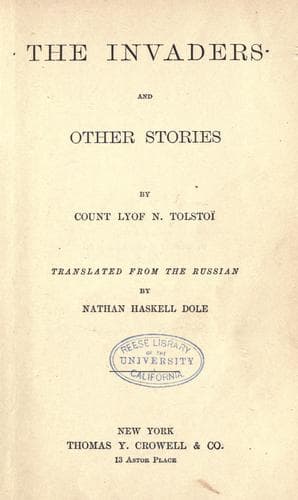
Russian fiction -- Translations into English; Short stories, Russian -- Translations into English
The artillery, with not a little spirit of rivalry with the infantry,
heaped up their piles; and soon the fire was already so well under way
that it was impossible to get within a couple of paces of it. The
dense black smoke arose through the icy branches, from which the water
dropped hissing into the flames, as the soldiers heaped them upon the
fire; and the glowing coals dropped down upon the dead white grass
exposed by the heat. It was all mere boy's play to the soldiers; they
dragged great logs, threw on the tall steppe grass, and fanned the fire
more and more.
As I came near a bonfire to light a cigarette, Velenchúk, always
officious, but, now that he had been found napping, showing himself
more actively engaged about the fire than any one else, in an excess
of zeal seized a coal with his naked hand from the very middle of
the fire, tossed it from one palm to the other, two or three times,
and flung it on the ground. "Light a match and give it to him," said
another. "Bring a lintstock, fellows," said still a third.
When I at last lighted my cigarette without the aid of Velenchúk, who
tried to bring another coal from the fire, he rubbed his burnt fingers
on the back of his sheepskin coat, and, doubtless for the sake of
exercising himself, seized a great plane-tree stump, and with a mighty
swing flung it on the fire. When at last it seemed to him that he might
rest, he went close to the fire, spread out his cloak, which he wore
like a mantle fastened at the back by a single button, stretched his
legs, folded his great black hands in his lap, and opening his mouth a
little, closed his eyes.
"Alas![2] I forgot my pipe! What a shame, fellows!" he said after a
short silence, and not addressing anybody in particular.
[Footnote 1: Yunker (German _Junker_) is a non-commissioned officer
belonging to the nobility. Count Tolstoi himself began his military
service in the Caucasus as a Yunker.]
[Footnote 2: _Ekh-ma._]
II.
In Russia there are three predominating types of soldiers, which
embrace the soldiers of all arms,--those of the Caucasus, of the line,
the guards, the infantry, the cavalry, the artillery, and the others.
These three types, with many subdivisions and combinations, are as
follows:--
(1) The obedient,
(2) The domineering or dictatorial, and
(3) The desperate.
The obedient are subdivided into the apathetic obedient and the
energetic obedient.
The domineering are subdivided into the gruffly domineering and the
diplomatically domineering.
The desperate are subdivided into the desperate jesters and the simply
desperate.
The type more frequently encountered than the rest--the type most
gentle, most sympathetic, and for the most part endowed with the
Christian virtues of meekness, devotion, patience, and submission to
the will of God--is that of the obedient.
The distinctive character of the apathetic obedient is a certain
invincible indifference and disdain of all the turns of fortune which
may overtake him.
Public-domain text, read in full here on John Shaqi.
Reviews
Reviews
No reviews yet
Be the first to share your thoughts on this work.
Join the Discussion
Join the discussion
Sign in to leave a comment or review.
Sign InorCreate an account