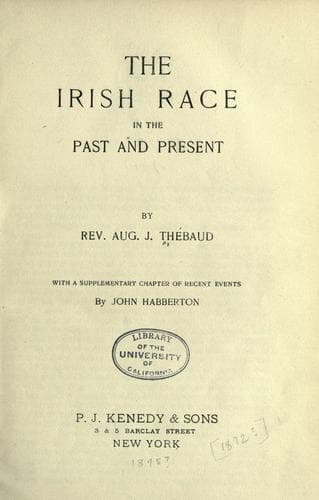
The Irish Race in the Past and the PresentThébaud, Augustus J.
History
The Irish Race in the Past and the Present
Thébaud, Augustus J.
Ireland -- History
Who can read the words of Christ, declaring that any one
invested with that dignity is sent by him as he was himself sent
by his Father, and not feel the innate respect due to such
divine honors? Who can read the details of those privileges with
respect to the remission of sin, the conferring of grace by the
sacraments, the infallible teaching of truth, the power even
granted to them sometimes over Nature and disease, without
feeling himself transported into a world far above this, and
without placing his confidence in what God himself has declared
so powerful and preeminent in the regions beyond?
Such, in a few words, is the Christian priesthood, if
Christianity possesses any reality and is not an imposture.
Among all nations, therefore, where sound faith exists, the
greatest respect is shown to the ministers of God; but the Irish
have at all times been most persistent in their veneration and
trust. And if we would ascertain the cause of their standing in
this regard, we shall find that other nations, while firmly
believing the words of Christ, keep their eyes open to human
frailty, and look more keenly and with more suspicion on the
conduct of men invested with so high a dignity, but subject at
the same time to earthly passions and sins; while the Irish, on
the contrary, abandon themselves with all the impulsiveness of
their nature to the feeling uppermost in their hearts, which is
ever one of trust and ready reliance.
But this statement, whatever may be its intrinsic value, itself
needs a further explanation, which is only to be found in the
greater attraction the supernatural always possessed for the
Irish nature, when developed by grace. They accept fully and
unsuspiciously what is heavenly, because they, more than others,
feel that they are made for heaven, and the earth, consequently,
has for them fewer attractions. They cling to a world far above
this, and whatever belongs to it is dear to them.
Hence, from the first preaching of Christianity among them, all
earthly dignities have paled before the heavenly honors of the
priesthood. They have been taught by St. Patrick that even the
supreme duties of a real Christian king fall far below those of
a Christian bishop.
The king, according to the apostle of Ireland - and his words
have become a canon of the Irish Church - "has to judge no man
unjustly; to be the protector of the stranger, of the widow, and
the orphan; to repress theft, punish adultery, not to keep
buffoons or unchaste persons; not to exalt iniquity, but to
sweep away the impious from the land, exterminate parricides and
perjurers; to defend the poor, to appoint just men over the
affairs of the kingdom, to consult wise and temperate elders, to
defend his native land against its enemies rightfully and
stoutly; in all things to put his trust in God."
Public-domain text, read in full here on John Shaqi.
Reviews
Reviews
No reviews yet
Be the first to share your thoughts on this work.
Elsewhere in the archive
Join the Discussion
Join the discussion
Sign in to leave a comment or review.
Sign InorCreate an account