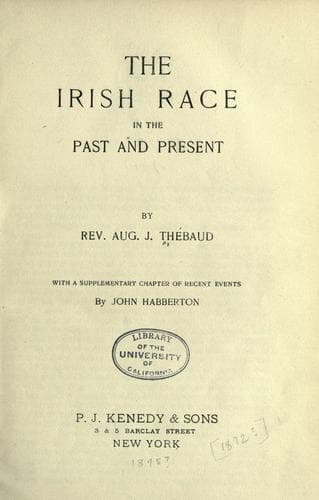
The Irish Race in the Past and the PresentThébaud, Augustus J.
History
The Irish Race in the Past and the Present
Thébaud, Augustus J.
Ireland -- History
The primitive, simple, patriarchal system of clanship was
Confronted by the stern, young, ferocious feudal system, which
was then beginning to prevail all over Europe. The question was,
Would Ireland consent to become European as Europe was then
organizing herself? The struggle, as we shall see, between the
Irish and the English in the twelfth century and later on, was
merely a contest between the sept system and feudalism, involving,
it is true, the possession of land. And, at the end of a contest
lasting four hundred years, feudalism was so thoroughly defeated
that the English of the Pale adopted the Irish manners, customs,
and even language, and formed only new septs among the old ones.
Hence Ireland escaped all the commotions produced in Europe by
the consequences of the feudal system:
I. Serfdom, which was generally substituted for slavery, never
existed in Ireland, slavery having disappeared before the entry
of the Anglo-Normans.
II. The universal oppression of the lower classes, which caused
the simultaneous rising of the communes all over Europe, never
having existed in Ireland, we shall not be surprised to find no
mention in Irish history of that wide-spread institution of the
eleventh and following centuries.
III. An immense advantage which Ireland derived from her isolation,
on which she always insisted, was her being altogether freed from
the fearful mediaeval heresies which convulsed France particularly
for a long period, and which invariably came from the East.
For Erin remained so completely shut off from the rest of Europe,
that, in spite of its ardent Catholicism, the Crusades were never
preached to its inhabitants; and, if some individual Irishman
joined the ranks of the warriors led to Palestine by Richard Coeur
de Lion, the nation was in no way affected by the good or bad
results which everywhere ensued from the marching of the Christian
armies against the Moslem.
The sects which sprang from Manicheism were certainly an evil
consequence of the holy wars; and it would be a great error to
think that those heresies were short-lived and affected only for
a brief space of time the social and moral state of Europe. It may
be said that their fearfully disorganizing influence lasts to this
day. If modern secret societies do not, in point of fact, derive
their existence directly from the Bulgarism and Manicheism of the
Middle Ages, there is no doubt that those dark errors, which Imposed
on all their adepts a stern secrecy, paved the way for the conspiracies
of our times. Hence Ireland, not having felt the effect of the former
heresies, is in our days almost free from the universal contagion now
decomposing the social fabric on all sides.
But it is chiefly in modern times that the successful resistance
offered by Ireland to many wide-spread European evils, and its
strong attachment to its old customs, will evoke our wonder.
Public-domain text, read in full here on John Shaqi.
Reviews
Reviews
No reviews yet
Be the first to share your thoughts on this work.
Join the Discussion
Join the discussion
Sign in to leave a comment or review.
Sign InorCreate an account