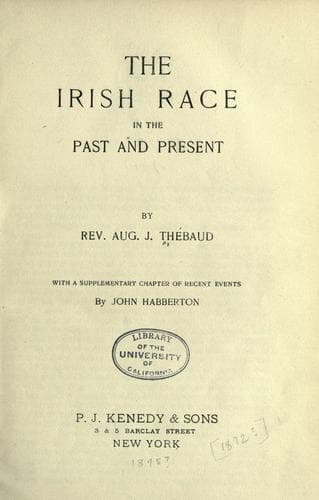
The Irish Race in the Past and the Present — John Shaqi
The Irish Race in the Past and the PresentThébaud, Augustus J.
History
The Irish Race in the Past and the Present
Thébaud, Augustus J.
Ireland -- History
Clanship reigned still over more than four-fifths of the island
when the Portuguese were conquering a great part of India, and
the Spaniards making Central and South America a province of
their almost universal monarchy.
The poets, harpers, antiquarians, genealogists, and students of
Brehon law, still held full sway over almost the whole island,
when the revival of pagan learning was, we may say, convulsing
Italy, giving a new direction to the ideas of Germany, and
penetrating France, Holland, and Switzerland. Happy were the
Irish to escape that brilliant but fatal invasion of mythology
and Grecian art and literature! Had they not received enough of
Greek and Latin lore at the hands of their first apostles and
missionaries, and through the instrumentality of the numerous
amanuenses and miniaturists in their monasteries and convents?
Those holy men had brought them what Christian Rome had purified
of the old pagan dross, and sanctified by the new Divine Spirit.
Virgin Ireland having thus remained undefiled, and never having
even been agitated by all those earlier causes of succeeding
revolutions, Protestantism, the final explosion of them all, could
make no impression on her--a fact which remains to this day the
brightest proof of her strength and vigor.
But, before speaking of this last conflict, we must meet an objection
which will naturally present itself.
To steadily refuse to enter into the current of European thought,
and object to submit in any way to its influence, is, pretend many,
really to reject the claims of civilization, and persist in refusing
to enter upon the path of progress. The North American savage has
always been most persistent in this stubborn opposition to civilized
life, and no one has as yet considered this a praiseworthy attribute.
The more barbarous a tribe, the more firmly it adheres to its
traditions, the more pertinaciously it follows the customs of its
ancestors. They are immovable, and cannot be brought to adopt
usages new to them, even when they see the immense advantages
they would reap from their adoption. Hence the greater number of
writers, chiefly English, who have treated of Irish affairs,
unhesitatingly call them barbarians, precisely on account of their
stubbornness in rejecting the advances of the Anglo-Norman invaders.
Sir John Davies, the attorney-general of James I., could scarcely
write a page on the subject without reverting to this idea.
Public-domain text, read in full here on John Shaqi.
Reviews
Reviews
No reviews yet
Be the first to share your thoughts on this work.
Join the Discussion
Join the discussion
Sign in to leave a comment or review.
Sign InorCreate an account