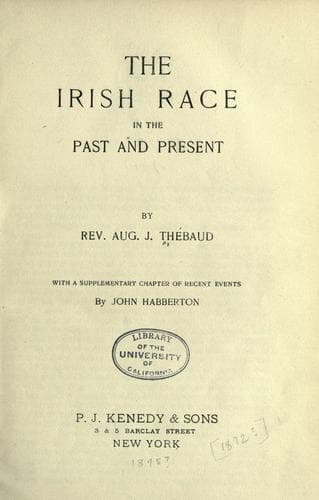
The Irish Race in the Past and the PresentThébaud, Augustus J.
History
The Irish Race in the Past and the Present
Thébaud, Augustus J.
Ireland -- History
All this evidently refers only to the exterior polity and
administration. But "the bishop must be the hand which supports,
the pilot who directs, the anchor that stays, the hammer that
strikes, the sun that enlightens, the dew which moistens, the
tablet to be written on, the book to be read, the mirror to be
seen in, the terror that terrifies, the image of all that is
good; and let him be all for all."
Under this metaphorical style we here discern all the interior
qualities of a spiritual Christian guide, teaching no less by
authority than example.
And, in the opinion of the converts of Patrick, were not the
bishops, abbots, and priests, supported by an invisible power,
stronger than all visible armies and guards of kings and princes?
"When the King of Cashel dared to contend against the holy abbot
Mochoemoc, the first night after the dispute an old man took the
king by the hand and led him to the northern city-walls; there
he opened the king's eyes, and he beheld all the Irish saints of
his own sex in white garments, with Patrick at their head; they
were there to protect Mochoemoc, and they filled the plain of
Femyn.
"The second night the old man came again and took the king to
the southern wall, and there he saw the white-robed glorious
army of Ireland's virgins, led by Bridget: they too had come to
defend Mochoemoc, and they filled the plain of Monael." 1
(1 Many quotations in this chapter are from the "Legend. Hist."
by J. G. Shea.)
In the annals of no other Christian nation do we see so many
examples of the power of the ministers of God to punish the
wicked and help and succor the good, as we do in the hagiography
of Ireland. Bad kings and chieftains reproved, cursed, punished;
the poor assisted, the oppressed delivered from their enemies,
the sick restored to health, the dead even raised to life, are
occurrences which the reader meets in almost every page of the
lives of Irish saints. The Bollandists, accustomed as they were
to meet with miracles of that kind, in the lives they published,
found in Irish hagiography such a superabundance of them, that
they refused to admit into their admirable compilation a great
number already published or in manuscript. Nevertheless, the
critics of our days, finding nothing impossible to or unworthy
of God in the large collection of Colgan and other Irish
antiquarians, express their surprise at their exclusion from
that of Bollandus.
Public-domain text, read in full here on John Shaqi.
Reviews
Reviews
No reviews yet
Be the first to share your thoughts on this work.
Elsewhere in the archive
Join the Discussion
Join the discussion
Sign in to leave a comment or review.
Sign InorCreate an account