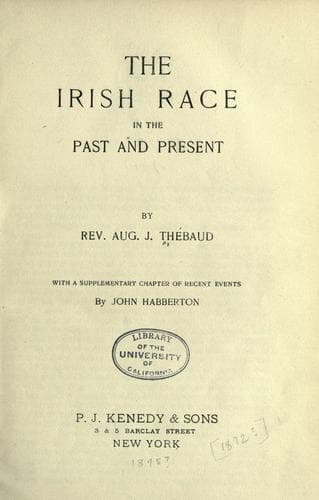
The Irish Race in the Past and the PresentThébaud, Augustus J.
History
The Irish Race in the Past and the Present
Thébaud, Augustus J.
Ireland -- History
No one at least will refuse to concede that, true or not, the
facts related in those lives are always provocative of piety and
redolent of faith. They certainly prove that at all periods of
their existence the Irish have manifested a holy avidity for
every thing supernatural and miraculous. Do they not know that
our Lord has promised gifts of this description to his apostles
and their successors? And what the acts of the Apostles and many
acts of martyrs positively state as having happened at the very
beginning of the Church, is not a whit less extraordinary or
physically impossible than any thing related in the Irish
legends.
Every Christian soul naturally abhors the unbelief of a Strauss
or of a Renan as to the former; is it not unnatural, then, for
the same Christian soul to reject the latter because they fall
under the easy sneer of "an Irish legend," and are not contained
in Holy Writ?
At all events, the faith of the Irish has never wavered in such
matters, and to-day they hold the same confidence in the
priests' power that meets us everywhere in the pages of Colgan
and Ward. The reason is, that they admit Christianity without
reserve; and in its entirety it is supernatural. The criticisms
of human reason on holy things hold in their eyes something of
the sacrilegious and blasphemous; such criticisms are for them
open disrespect for divine things; and, inasmuch as divine
things are, in fact, more real than any phenomena under natural
laws can be, skepticism in the former case is always more
unreasonable than in the latter, supposing always that the
narrative of the Divine favors reposes on sufficient authority.
It is clear, therefore, that since the preaching of Christianity
in Ireland, the world showed itself to the inhabitants of that
country in a different light to that in which other men beheld
it. For them, Nature is never separated from its Maker; the hand
of God is ever visible in all mundane affairs, and the frightful
parting between the spiritual and material worlds, first
originated by the Baconian philosophy, which culminates in our
days in the almost open negation of the spiritual, and thus
materializes all things, is with justice viewed by the children
of St. Patrick with a holy horror as leading to atheism, if it
be not atheism itself.
Public-domain text, read in full here on John Shaqi.
Reviews
Reviews
No reviews yet
Be the first to share your thoughts on this work.
Elsewhere in the archive
Join the Discussion
Join the discussion
Sign in to leave a comment or review.
Sign InorCreate an account