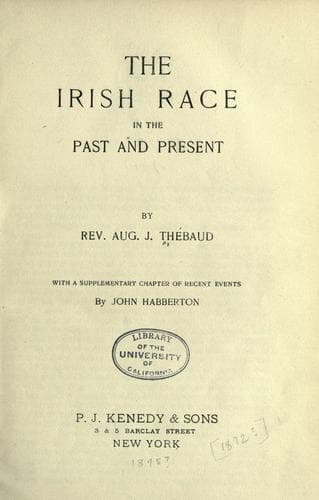
The Irish Race in the Past and the PresentThébaud, Augustus J.
History
The Irish Race in the Past and the Present
Thébaud, Augustus J.
Ireland -- History
Without going to such extremes as the avowed infidels of modern
times, all other Christian nations have seemed afraid to draw
the logical conclusions whose premises were laid down by
revelation. They have tried to follow a _via media_ between
truth and error; they have admitted to a certain extent the
separation of God and Nature, supposing the act of creation to
have passed long ages ago, and not continuing through all time;
and thus they are bound by their system to hold that miracles
are very extraordinary things, not to be believed _prima facie_,
requiring infinite precautions before admitting the supposition
of their having taken place; all which indicates a real
repugnance to their admission, and an innate fear of supposing
God all-powerful, just, and good. It is the first step to
Manicheism and the kindred errors; and most Christian nations
having, unfortunately, imbibed the principles of those errors in
the philosophy of modern times, have almost lost all faith in
the supernatural, and reduced revelation to a meagre and cold
system, unrealized and not to be realized in human life.
Not so the Irish Religion has entered deep into their life. It
is a thing of every moment and of every place. Nature, God's
handiwork, instead of repelling them from God himself, draws
them gently but forcibly toward Him, so that they feel
themselves to be truly recipients of the blessings of God by
being sharers in the blessings of Nature.
And must God's ministers, who have received such extraordinary
powers over the supernatural world, be entirely deprived of
power over the inferior part of creation? Who can say so, and
have true faith in the words of our Lord? Who can say so, and
truly call himself the follower and companion of the saints who
have all believed so firmly in the constant action of God in
this, the lesser part of his creation?
And this faith of the Irish in the power of the priesthood is
not a thing of yesterday. It dates from their adoption of
Christianity, to continue, we hope, forever. It ought, therefore,
to be carefully distinguished from that love for every priest
of God which beats so ardently in the hearts of them all, and
which was so strengthened by a long community of persecution and
suffering.
In Ireland, as in every other Christian country, the priesthood
has always sided with the people against their oppressors.
During the early ages of Christianity in the island, the bishops,
priests, and monks, were often called upon to exercise their
authority and power against princes and chiefs of clans,
accustomed to plunder, destroy, and kill, on the slightest
pretext, and unused to control their fierce passions, inflamed
by the rancor of feuds and the pride of strength and bravery.
Some of those chieftains even opposed the progress of religion;
and it is said that Eochad, King of Ulster, cast his two
daughters, whom Patrick had baptized and consecrated to God,
into the sea.
Public-domain text, read in full here on John Shaqi.
Reviews
Reviews
No reviews yet
Be the first to share your thoughts on this work.
Elsewhere in the archive
Join the Discussion
Join the discussion
Sign in to leave a comment or review.
Sign InorCreate an account