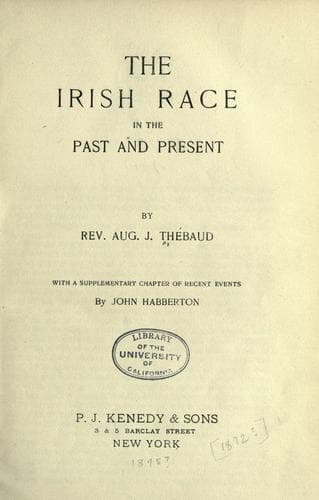
The Irish Race in the Past and the PresentThébaud, Augustus J.
History
The Irish Race in the Past and the Present
Thébaud, Augustus J.
Ireland -- History
For several centuries the heads of clans were generally so
unruly and so hard to bring under the yoke of Christ, that the
saints, in taking the side of the poor, had to stand as a wall
of brass to stem the fury of the great and powerful.
Bridget even, the modest and tender virgin, often spoke harshly
of princes and rulers. "While she dwelt in the land of Bregia,
King Connal's daughter-in-law came to ask her prayers, for she
was barren. Bridget refused to go to receive her; but, leaving
her without, she sent one of her maidens. When the nun returned:
'Mother,' she asked, 'why would you not go and see the queen?
you pray for the wives of peasants.' 'Because,' said the servant
of God, 'the poor and the peasants are almost all good and pious,
while the sons of kings are serpents, children of blood and
fornication, except a small number of elect. But, after all, as
she had recourse to us, go back and tell her that she shall have
a son; he will be wicked, and his race shall be accursed, yet he
shall reign many years.'"
We might multiply examples such as this, wherein the saints and
the ministers of God always side with the poor and the helpless;
and their great number in the lives of the old saints at once
gives a reason for the deep love which the lower class of the
Irish people felt for the holy men who were at once the servants
of God and their helpers in every distress.
The same thing is to be found in the whole subsequent history of
the island, chiefly in the latter ages of persecution. But, as
we said before, this affection and love must be distinguished
from the feeling of reverence and awe resulting from the
supernatural character of their office. The first feeling is
merely a natural one, produced by deeds of benevolence and holy
charity fondly remembered by the individuals benefited. The
second was the effect of religious faith in the sacredness of
the priestly character, and remained in full force even when the
poor themselves fell under reproof or threat in consequence of
some misdeed or vicious habit.
Hence the universal respect which the whole race entertains for
their spiritual rulers, and their unutterable confidence in
their high prerogatives. In prosperity as in adversity, in
freedom or in subjection, they always preserve an instinctive
faith in the unseen power which Christ conferred on those whom
He chose to be his ministers. This feeling, which is undoubtedly
found among good Christians in all places, is as certainly only
found among particular individuals; but among the Irish Celts it
is the rule rather than the exception.
Well have they merited, then, in this sense, from the days of St.
Patrick down, the title of a "priest-ridden" people, which has
been fixed on them as a term of reproach by those for whom all
belief in the supernatural is belief in imposture.
Public-domain text, read in full here on John Shaqi.
Reviews
Reviews
No reviews yet
Be the first to share your thoughts on this work.
Elsewhere in the archive
Join the Discussion
Join the discussion
Sign in to leave a comment or review.
Sign InorCreate an account