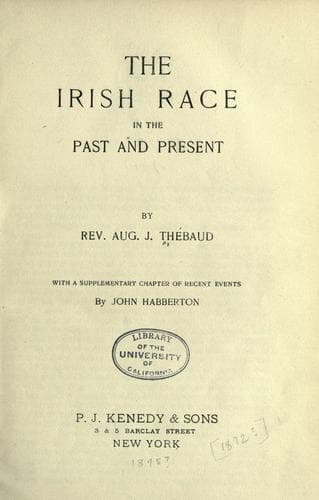
The Irish Race in the Past and the PresentThébaud, Augustus J.
History
The Irish Race in the Past and the Present
Thébaud, Augustus J.
Ireland -- History
For the clans rallied to the defence of the Church. Though the
chieftains and their clansmen might seem to have failed fully to
imbibe the spirit of religion, though in their insane feuds they
often turned a deaf ear to the remonstrances and reproaches of
the bishops and monks, nevertheless Christianity reigned supreme
in their inmost hearts. And when they beheld pagans landed on
their shores, to insult their faith and destroy the monuments of
their religion, to shed the blood of holy men, of consecrated
virgins, and of innocent children, they turned that bravery
which they had so often used against themselves and for the
satisfaction of worthless contentions into a new and a more
fitting channel--the defence of their altars and the punishment
of sacrilegious outrage.
The clan system was the very best adapted for this kind of
warfare, so long as no large fleets came, and the pirates were
too few in number and too sagacious in mind to think of
venturing far inland. When but a small number of boats arrived,
the invaders found in the neighborhood a clan ready to receive
them. The clansmen speedily assembled, and, falling on the
plundering crews, showed them how different were the free men of
a Celtic coast, who were inspired by a genuine love for their
faith, from the degenerate sons of the Gallo-Romans.
So the annals of the country tell us that the "foreigners" were
destroyed in 812 by the men of Umhall in Mayo; by Corrach, lord
of Killarney, in the same year; by the men of Ulidia and by
Carbry with the men of Hy-Kinsella in 827; by the clansmen of Hy-
Figeinte, near Limerick, in 834, and many more.
But the hydra had a thousand heads, and new expeditions were
continually arriving. In the words of Mr. Worsaae, a Danish
writer of this century:
"From time immemorial Ireland was celebrated in the Scandinavian
north, for its charming situation, its mild climate, and its
fertility and beauty. The Kongspell--mirror of Kings--which was
compiled in Norway about the year 1200, says that Ireland is
almost the best of the lands we are acquainted with although no
vines grow there. The Scandinavian Vikings and emigrants, who
often contented themselves with such poor countries as Greenland
and the islands in the north Atlantic, must, therefore, have
especially turned their attention to the 'Emerald Isle,'
particularly as it bordered closely upon their colonies in
England and Scotland. But to make conquests in Ireland, and to
acquire by the sword alone permanent settlements there, was no
easy task.... When we consider that neither the Romans nor the
Anglo-Saxons ever obtained a footing in that country, although
they had conquered England, the adjacent isle, and when we
further reflect upon the immense power exerted by the English in
later times in order to subdue the Celtic population of the
island, we cannot help being surprised at the very considerable
Scandinavian settlements which, as early as the ninth century,
were formed in that country."
Public-domain text, read in full here on John Shaqi.
Reviews
Reviews
No reviews yet
Be the first to share your thoughts on this work.
Elsewhere in the archive
Join the Discussion
Join the discussion
Sign in to leave a comment or review.
Sign InorCreate an account