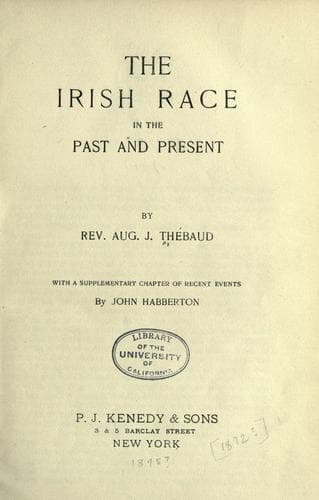
The Irish Race in the Past and the PresentThébaud, Augustus J.
History
The Irish Race in the Past and the Present
Thébaud, Augustus J.
Ireland -- History
If any one insists that such was not the case, he must of necessity
admit that the oral teaching of the Ollamhs was so perfect and so
universally current in the same formulas all over the island, that
such oral teaching really took the place of writing; and in this
case, also, which is scarcely possible, however, Ireland had an
authentic history. This last supposition, certainly, can hardly
be credited; and yet, if the first be rejected, it must be admitted,
since it cannot be imagined that subsequent Irish historians,
numerous as they became in time, could have agreed so well
together, and remained so consistent with themselves, and so
perfectly accurate in their descriptions of places and things in
general, without anterior authentic documents of some kind or other,
on which they could rely. Any person who has merely glanced at
the astonishing production called the "Annals of the Four Masters,"
must necessarily be of this opinion.
In no nation in the world are there found so many old histories,
annals, chronicles, etc., as among the Irish; and that fact alone
suffices to prove that in periods most ancient they were truly a
civilized nation, since they attached such importance to the
records of events then taking place among them.
But the Irish were, moreover, a branch of the great Celtic race,
whose renown for wisdom, science, and valor, was spread through
all parts, particularly among the Greeks. The few details we
purpose giving on the subject will convince the reader that among
the nations of antiquity they held a prominent position; and not
only were they possessed of a civilization of their own, not
despicable even in the eyes of a Roman--of the great Julius
himself--but they were ever most susceptible of every kind of
progress, and consequently eager to adopt all the social benefits
which their intercourse with Rome brought them. At least, they
did so as soon as, acknowledging the superior power of the enemy,
they had the good sense to feel that it was all-important to
imitate him. Hence sprang that Gallo-Roman civilization which
obtained during the first five or six centuries of the Christian
era--a civilization which the barbarians of the North endeavored
to destroy, but to which they themselves finally yielded, by
embracing Christianity, and gradually changing their language
and customs.
Everywhere--in Gaul, Italy, Britain, and Ireland--did the Celts
manifest that susceptibility to progress which is the invariable
mark of a state antagonistic to barbarism. In this they totally
differed from the Vandals and Huns, whom it took the Church such
a dreary period to conquer, and whom no other power save the
religion of Christ could have subdued.
These few words are sufficient for our present purpose. We proceed
to show that, in their stubborn opposition to many a current of
European opinion, they acted rightly.
Public-domain text, read in full here on John Shaqi.
Reviews
Reviews
No reviews yet
Be the first to share your thoughts on this work.
Join the Discussion
Join the discussion
Sign in to leave a comment or review.
Sign InorCreate an account