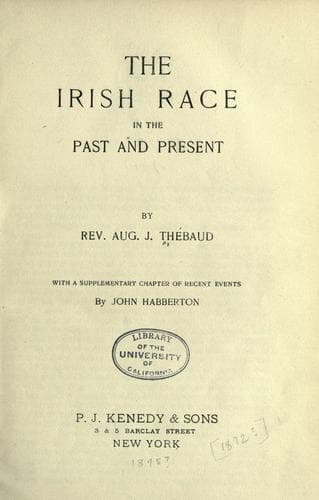
The Irish Race in the Past and the PresentThébaud, Augustus J.
History
The Irish Race in the Past and the Present
Thébaud, Augustus J.
Ireland -- History
They acted rightly, first of all, in excluding from their course
of studies at Bangor, Clonfert, Armagh, Clonmacnoise, and other
places, the subtleties of Greek philosophy, which occasioned
heresies in Europe and Asia during the first ages of the Church,
and were the cause of so many social and political convulsions.
By adhering strictly---a little too strictly, perhaps--to their
traditional method of developing thought, they kept error far from
their universities, and presented, in the sixth, seventh, and eighth
centuries, the remarkable spectacle in Ireland, France, Germany,
Switzerland, and even Northern Italy, of numerous schools wherein
no wrangling found a place, and whence never issued a single
proposition which Rome found reason to censure. They were at that
time the educators of Christian Europe, and not even a breath of
suspicion was ever raised against any one of their innumerable
teachers. If their mind, in general, did not on that account
attain the acuteness of the French, Italians, or Germans, it was
at all times safer and more guarded. Even their later hostility
to the English Pale, after the eleventh century, was most useful,
from its warning against the teachings of prelates sent from the
English Universities of Oxford and Cambridge; and Rome seems to
have approved of that opposition, by using all her power in
appointing to Irish sees, even within the Pale, prelates chosen
from the Augustinian, Dominican, Franciscan, and Carmelite orders,
in preference to secular ecclesiastics educated in the great seats
of English learning.
Thus the Irish, by opening their schools gratuitously to all Europe,
but chiefly to Anglo-Saxon England, were not only of immense service
to the Church, but showed how fully they appreciated the benefits
of true civilization, and how ready they were to extend it by their
traditional teaching. Nor did they confine themselves to receiving
scholars in their midst: they sent abroad, during those ages, armies
of zealous missionaries and learned men to Christianize the heathen,
or educate the newly-converted Germanic tribes in Merovingian and
Carlovingian Gaul, in Anglo-Saxon and Scandinavian England, in
Lombardian Italy, in the very hives of those ferocious tribes
which peopled the ever-moving and at that time convulsed Germany.
II. They were right in refusing to submit to the Scandinavian yoke,
and accept from those who would impose it their taste for city life,
and the spirit of maritime enterprise and extensive commerce. We
shall see that this was at the bottom of their two centuries of
struggle with the Danes; that they were animated throughout that
conflict by their ardent zeal for the Christian religion, which
the Northmen came to destroy. There is no need of dwelling on this
point, as we are not aware that any one, even their bitterest
enemies, has found fault with them here.
Public-domain text, read in full here on John Shaqi.
Reviews
Reviews
No reviews yet
Be the first to share your thoughts on this work.
Join the Discussion
Join the discussion
Sign in to leave a comment or review.
Sign InorCreate an account