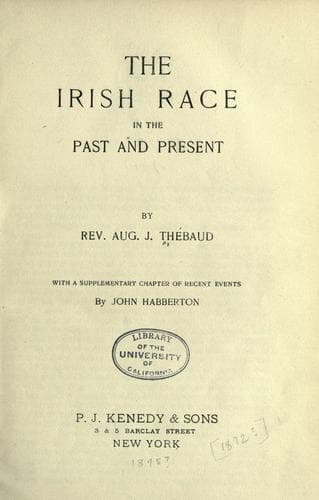
The Irish Race in the Past and the PresentThébaud, Augustus J.
History
The Irish Race in the Past and the Present
Thébaud, Augustus J.
Ireland -- History
These are the words of a Dane. We shall see what the "very
considerable Scandinavian settlements" amounted to; the
quotation is worthy of note, as presenting in a few words the
motives of those who at any time invaded Ireland, and the
stubborn resistance which they met.
The Irish were not dismayed by the constant arrivals of those
northern hordes. They met them one after another without
considering their complexity and connection. They only saw a
troop of fierce barbarians landed on their shores, chiefly
intent upon plundering and burning the churches and holy houses
which they had erected; they saw their island, hitherto
protected by the ocean from foreign attack, and resting in the
enjoyment of a constant round of Christian festivals and joyful
feasts, now desecrated by the presence and the fury of ferocious
pagans; they armed for the defence of all that is dear to man;
and though, perhaps, at first beaten and driven back, they
mustered in force at a distance to fall on the victors with a
swoop of noble birds who fly to the defence of their young.
This kind of contest continued for two hundred years, with the
exception of the periods of larger invasions, when a single clan
no longer sufficed to avenge the cause of God and humanity, and
the Ard-Righ was compelled to throw himself on the scene at the
head of the whole collective force of the nation in order to
oppose the vast fleets and large armies of the Danes.
The country suffered undoubtedly; the cattle were slain; the
fields devastated; the churches and houses burned; the poets
silenced or woke their song only to notes of woe; the harpers
taught the national instrument the music of sadness; the
numerous schools were scattered, though never destroyed; as
centuries later, under the Saxon, the people took their books or
writing materials to their miserable cottages or hid them in the
mountain fastnesses, and thus, for the first time in their
history, the hedge school succeeded those of the large
monasteries. So the nation continued to live on, the energetic
fire which burned in the hearts of the people could not be
quenched. They rose and rose again, and often took a noble
revenge, never disheartened by the most utter disaster.
On three different occasions this bloody strife assumed a yet
more serious and dangerous aspect. It was not a few boats only
which came to the shores of the devoted island; but the main
power of Scandinavia seemed to combine in order to crush all
opposition at a single blow.
Public-domain text, read in full here on John Shaqi.
Reviews
Reviews
No reviews yet
Be the first to share your thoughts on this work.
Elsewhere in the archive
Join the Discussion
Join the discussion
Sign in to leave a comment or review.
Sign InorCreate an account