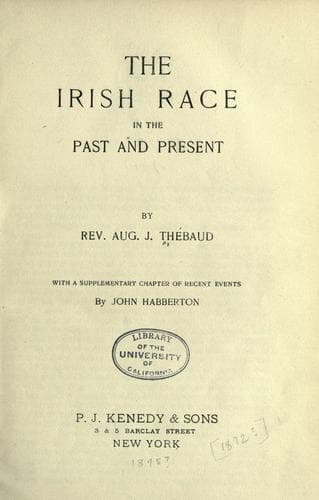
The Irish Race in the Past and the PresentThébaud, Augustus J.
History
The Irish Race in the Past and the Present
Thébaud, Augustus J.
Ireland -- History
When the knowledge of the richness, fertility, and beauty of the
island had fully spread throughout Denmark and Norway, a large
fleet gathered in the harbors of the Baltic and put to sea. The
famous Turgesius or Turgeis--Thorgyl in the Norse--was the
leader. The Edda and Sagas of Norway and Denmark have been
examined with a view to elucidate this passage in Irish history,
but thus far fruitlessly. It is known, however, that many Sagas
have been lost which might have contained an account of it. The
Irish annals are too unanimous on the subject to leave any
possibility of doubt with regard to it; and, whatever may be the
opinion of learned men on the early events in the history of
Erin, the story of the eighth, ninth, and tenth centuries rests
entirely on historical ground, as surely as if the facts had
happened a few hundred years ago.
Turgesius landed with his fleet on the northeast coast of the
island, and straightway the scattered bands of Scandinavians
already in the country acknowledged his leadership and flocked
to his standard. McGeoghegan says that "he assumed in his own
hands the sovereignty of all the foreigners that were then in
Ireland."
From the north he marched southward; and, passing Armagh on his
route, attacked and took it, and plundered its shrines,
monasteries, and schools. There were then within its walls seven
thousand students, according to an ancient roll which Keating
says has been discovered at Oxford. These were slaughtered or
dispersed, and the same fate attended the nine hundred monks
residing in its monasteries.
Foraanan, the primate, fled; and the pagan sea-kong, entering
the cathedral, seated himself on the primatial throne, and had
himself proclaimed archbishop.--(O'Curry.) He had shortly before
devastated Clonmacnoise and made his wife supreme head of that
great ecclesiastical centre, celebrated for its many convents of
holy women. The tendency to add insult to outrage, when the
object of the outrage is the religion of Christ, is old in the
blood of the northern barbarians; and Turgesius was merely
setting the example, in his own rude and honest fashion, to the
more polished but no less ridiculous assumption of
ecclesiastical authority, which was to be witnessed in England,
on the part of Henry VIII. and Elizabeth.
Public-domain text, read in full here on John Shaqi.
Reviews
Reviews
No reviews yet
Be the first to share your thoughts on this work.
Elsewhere in the archive
Join the Discussion
Join the discussion
Sign in to leave a comment or review.
Sign InorCreate an account