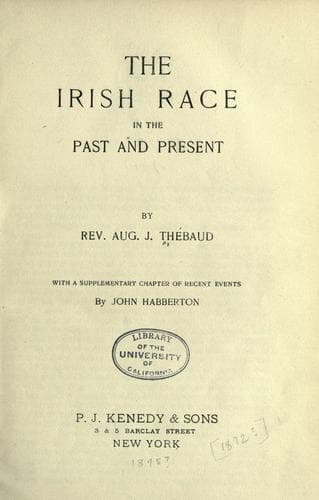
The Irish Race in the Past and the PresentThébaud, Augustus J.
History
The Irish Race in the Past and the Present
Thébaud, Augustus J.
Ireland -- History
The power of the invader was so superior to whatever forces the
neighboring Irish clans could muster, that no opposition was
even attempted at first by the indignant witnesses of those
sacrileges. It is even said that at the very time when the
Northmen were pillaging and burning in the northeast of the
island, the men of Munster were similarly employed in Bregia;
and Conor, the reigning monarch of Ireland, instead of defending
the invaded territories, was himself hard at work plundering
Leinster to the banks of the river Liffey--(Haverty.) But,
doubtless, none of those deluded Irish princes had yet heard of
the pagan devastations and insults to their religion, and thus
it was easy for the great sea-kong to strengthen and extend his
power. For the attainment of his object he employed two powerful
agents which would have effectually crushed Ireland forever, if
the springs of vitality in the nation had not been more than
usually expansive and strong.
The political ability of the Danes began to show itself in
Ireland, as it did about the same period (830) in England, and
later on in France. Turgesius saw that, in order to subdue the
nation, it was necessary to establish military stations in the
interior and fortify cities on the coast, where he could receive
reinforcements from Scandinavia. These plans he was prompt to
put into practice.
His military stations would have been too easily destroyed by
the bravery of the Irish, strengthened by the elasticity of
their clan-system, if they were, planted on land. He, therefore,
set them in the interior lakes which are so numerous in the
island, where his navy could repel all the attacks of the
natives, unused as they were to naval conflicts. He stationed a
part of his fleet on Lough Lee in the upper Shannon, another in
Lough Neagh, south of Antrim, a third in Lough Lughmagh or
Dundalk bay. These various military positions were strongholds
which secured the supremacy of the Scandinavians in the north of
the island for a long time. In the south, Turgesius relied on
the various cities which his troops were successively to build
or enlarge, namely, Dublin, Limerick, Galway, Cork, Waterford,
and Wexford. This first Scandinavian ruler could begin that
policy only by establishing his countrymen in Dublin, which they
seized in 836.
Public-domain text, read in full here on John Shaqi.
Reviews
Reviews
No reviews yet
Be the first to share your thoughts on this work.
Elsewhere in the archive
Join the Discussion
Join the discussion
Sign in to leave a comment or review.
Sign InorCreate an account