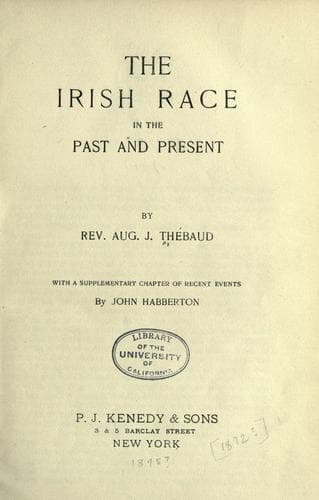
The Irish Race in the Past and the PresentThébaud, Augustus J.
History
The Irish Race in the Past and the Present
Thébaud, Augustus J.
Ireland -- History
Up to that time the Irish had scarcely any city worthy of the
name. A patriarchal people, they followed the mode of life of
the old Eastern patriarchs, who abhorred dwelling in large towns.
Until the invasion of the Danes, the island was covered with
farm-houses placed at some distance from each other. Here and
there large _duns_ or _raths_, as they were called, formed the
dwellings of their chieftains, and became places of refuge for
the clansmen in time of danger. Churches and monasteries arose
in great numbers from the time of St. Patrick, which were first
built in the woods, but soon grew into centres of population,
corresponding in many respects to the idea of towns as generally
understood.
The Northmen brought with them into Ireland the ideas of cities,
commerce, and municipal life, hitherto unknown. The introduction
of these supposed a total change necessary in the customs of the
natives, and stringent regulations to which the people could not
but be radically opposed. And strange was their manner of
introduction by these northern hordes. Keating tells us how
Turgesius understood them. They were far worse than the
imaginary laws of the Athenians as recorded in the "Birds" of
Aristophanes. No more stringent rules could be devised, whether
for municipal, rural, or social regulations; and, as the
Northmen are known to have been of a systematic mind, no
stronger proof of this fact could be given.
Keating deplores in the following terms the fierce tyranny of
the Danish sea-kong:
"The result of the heavy oppression of this thraldom of the
Gaels under the foreigner was, that great weariness thereof came
upon the men of Ireland, and the few of the clergy that survived
had fled for safety to the forests and wildernesses, where they
lived in misery, but passed their time piously and devoutly, and
now the same clergy prayed fervently to God to deliver them from
that tyranny of Turgesius, and, moreover, they fasted against
that tyrant, and they commanded every layman among the faithful,
that still remained obedient to their voice, to fast against him
likewise. And God then heard their supplications in as far as
the delivering of Turgesius into the hands of the Gaels."
Thus in the ninth century the subsequent events of the sixteenth
and seventeenth were foreshadowed. The judicious editor of
Keating, however, justly remarks, that this description, taken
mainly from Cambrensis, is not supported in its entirety by the
contemporaneous annals of the island; that the power of the
Danes never was as universal and oppressive as is here supposed;
and that though each of the facts mentioned may have actually
taken place in some part of the country, at some period of the
Danish invasion, yet the whole, as representing the actual state
of the entire island at the time, is exaggerated and of too
sweeping a nature.
Public-domain text, read in full here on John Shaqi.
Reviews
Reviews
No reviews yet
Be the first to share your thoughts on this work.
Elsewhere in the archive
Join the Discussion
Join the discussion
Sign in to leave a comment or review.
Sign InorCreate an account