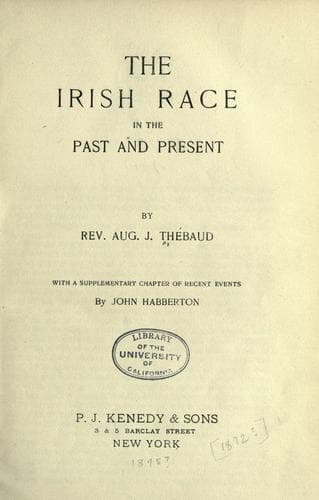
The Irish Race in the Past and the PresentThébaud, Augustus J.
History
The Irish Race in the Past and the Present
Thébaud, Augustus J.
Ireland -- History
It is clear, nevertheless, that the domination of the Northmen
could not have been completely established in Ireland, together
with their notions of superiority of race, trade on a large
scale, and a consequent agglomeration of men in large cities,
without the total destruction of the existing social state of
the Irish, and consequently something of the frightful tyranny
just described.
But the people were too brave, too buoyant, and too ardent in
their nature, to bear so readily a yoke so heavy. They were too
much attached to their religion, not to sacrifice their lives,
if necessary, in order to put an end to the sacrilegious
usurpations of a pagan king, profaning, by his audacious
assumptions, the noblest, highest, purest, and most sacred
dignities of holy Church. A man, stained with the blood of so
many prelates and priests, seated on the primatial throne of the
country in sheer derision of their most profound feelings; his
pagan wife ruling over the city which the virgins of Bridget,
the spouses of Christ, had honored and sanctified so long; their
religion insulted by those who tried to destroy it--how could
such a state of things be endured by the whole race, not yet
reduced to the condition to which so many centuries of
oppression subsequently brought it down!
Hence Keating could write directly after the passage just quoted:
"When the nobles of Ireland saw that Turgesius had brought
confusion upon their country, and that he was assuming supreme
authority over themselves, and reducing them to thraldom and
vassalage, they became inspired with a fortitude of mind, and a
loftiness of spirit, and a hardihood and firmness of purpose,
that urged them to work in right earnest, and to toil zealously
in battle against him and his murdering hordes."
And hereupon the faithful historian gives a long list of
engagements in which the Irish were successful, ending with the
victory of Malachi at Glas Linni, where we know from the Four
Masters that Turgesius himself was taken prisoner and afterward
drowned in Lough Uair or Owell in West Meath, by order of the
Irish king.
This prince, then monarch of the whole island, atoned for the
apathy and the want of patriotism of his predecessors, Conor and
the Nialls. He was in truth a saviour of his country, and the
death of the oppressor was the signal for a general onslaught
upon the "foreigners" in every part of the island.
"The people rose simultaneously, and either massacred them in
their towns, or defeated them in the fields, so that, with the
exception of a few strongholds, like Dublin, the whole of
Ireland was free from the Northmen. Wherever they could escape,
they took refuge in their ships, but only to return in more
numerous swarms than before." - (M. Haverty.)
Public-domain text, read in full here on John Shaqi.
Reviews
Reviews
No reviews yet
Be the first to share your thoughts on this work.
Elsewhere in the archive
Join the Discussion
Join the discussion
Sign in to leave a comment or review.
Sign InorCreate an account