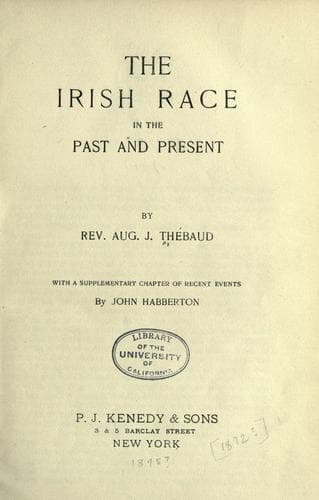
The Irish Race in the Past and the PresentThébaud, Augustus J.
History
The Irish Race in the Past and the Present
Thébaud, Augustus J.
Ireland -- History
It is evident that their deep sense of religion was the chief
source of the energy which the Irish then displayed. They had
not yet been driven into a fierce resistance by being forcibly
deprived of their lands; although the Danes, when they carried
their vexatious tyranny into all the details of private life -
not allowing lords and ladies of the Irish race to wear rich
dresses and appear in a manner befitting their rank - when they
went so far as to refuse a bowl of milk to an infant, that a
rude soldier might quench his thirst with it - could have
scarcely permitted the apparently conquered people to enjoy all
the advantages accruing to the owner from the possession of land.
Yet in none of the chronicles of the time which we have seen is
any mention made of open confiscation, and of the survey and
division of the territory among the greedy followers of the sea-
kong. We do not yet witness what happened shortly after in
Normandy under Rollo, and what was to happen four hundred years
later in Ireland. The Scandinavians had not yet attained that
degree of civilization which makes men attach a paramount
importance to the possession of a fixed part of any territory,
and call in surveys, title-deeds, charters, and all the written
documents necessitated by a captious and over-scrupulous
legislation. The Irish, consequently, did not perceive that
their broad acres were passing into the control of a foreign
race, and were being taken piecemeal from them, thus bringing
them gradually down to the condition of mere serfs and
dependants.
What they did see, beyond the possibility of mistake or
deception, was their religion outraged, their spiritual rulers,
not merely no longer at liberty to practise the duties of their
sacred ministry, but hunted down and slaughtered or driven to
the mountains and the woods. They saw that pagans were actually
ruling their holy isle, and changing a paradise of sanctity into
a pandemonium of brutal passion, presided over by a
superstitious and cruel idolatry. For surely, although the Irish
chronicles fail to speak of it, the minstrels and historians
being too full of their own misery to think of looking at the
pagan rites of their enemies - those enemies worshipped Thor and
Odin and Frigga, and as surely did they detest the Church which
they were on a fair way to destroy utterly. This it was which
gave the Irish the courage of despair. For this cause chiefly
did the whole island fly to arms, fall on their foes and bring
down on their heads a fearful retribution. This it was,
doubtless, which breathed into the new monarch the energy which
he displayed on the field of Glas Linni; and when he ordered the
barbarian, now a prisoner in his hands, to be drowned, it was
principally as a sign that he detested in him the blasphemer and
the persecutor of God's church.
Public-domain text, read in full here on John Shaqi.
Reviews
Reviews
No reviews yet
Be the first to share your thoughts on this work.
Elsewhere in the archive
Join the Discussion
Join the discussion
Sign in to leave a comment or review.
Sign InorCreate an account