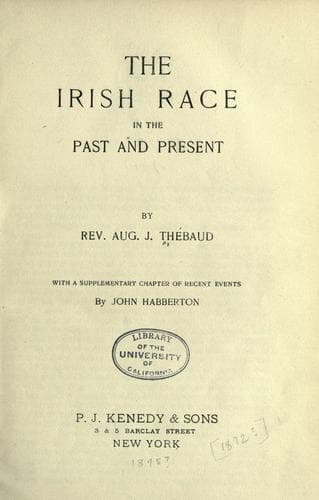
The Irish Race in the Past and the PresentThébaud, Augustus J.
History
The Irish Race in the Past and the Present
Thébaud, Augustus J.
Ireland -- History
Thus did the first national misfortunes of this Celtic people
become the means of enkindling in their hearts a greater love
for their religion, and a greater zeal for its preservation in
their midst.
Ireland was again free; and, although we have no details
concerning the short period of prosperity which followed the
overthrow of the tyranny we have touched upon, we have small
doubt that the first object of the care of those who, under God,
had worked their own deliverance, was to repair the ruins of the
desecrated sanctuaries and restore to religion the honor of
which it had been stripped.
The Danes themselves came to see that they had acted rashly in
striving to deprive the Irish of a religion which was so dear to
their hearts; they resolved on a change of policy, as they were
still bent on taking possession of the island, which Mr. Worsaae
has told us they considered the best country in existence.
They resolved, therefore, to act with more prudence, and to make
use of trade and the material blessings which it confers, in
order to entice the Irish to their destruction, by allowing the
Northmen to carry on business transactions with them and so
gradually to dwell among them again. Father Keating tells the
story in his quaint and graphic style:
"The plan adopted by them on this occasion was to equip three
captains, sprung from the noblest blood of Norway, and to send
them with a fleet to Ireland, for the object of obtaining some
station for purpose of trade. And with them they accordingly
embarked many tempting wares, and many valuable jewels -- with
the design of presenting them to the men of Ireland, in the hope
of thus securing their friendship; for they believed that they
might thus succeed in surreptitiously fixing a grasp upon the
Irish soil, and might be enabled to oppress the Irish people
again . . . . The three captains, therefore, coming from the
ports of Norway, landed in Ireland with their followers, as if
for the purpose of demanding peace, and under the pretext of
establishing a trade; and there, with the consent of the Irish,
who were given to peace, they took possession of some sea-board
places, and built three cities thereon, to wit: Waterford,
Dublin, and Limerick."
We see, then, the Scandinavians abandoning their first project
of conquering the North to fall on the South and confining
themselves to a small number of fortified sea-ports.
The first result of this policy was a firmer hold than ever on
Dublin, once already occupied by them in 836. "Amlaf, or Olaf,
or Olaus, came from Norway to Ireland in 851, so that all the
foreign tribes in the island submitted to him, and they
extracted rent from the Gaels." - (Four Masters.)
Public-domain text, read in full here on John Shaqi.
Reviews
Reviews
No reviews yet
Be the first to share your thoughts on this work.
Elsewhere in the archive
Join the Discussion
Join the discussion
Sign in to leave a comment or review.
Sign InorCreate an account