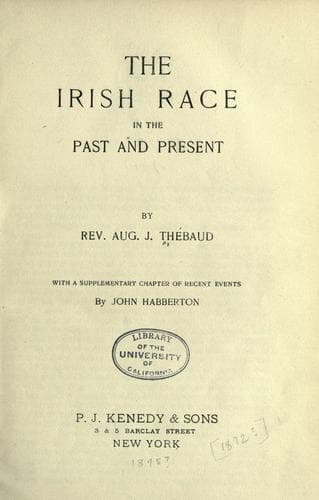
The Irish Race in the Past and the PresentThébaud, Augustus J.
History
The Irish Race in the Past and the Present
Thébaud, Augustus J.
Ireland -- History
From that time to the twelfth century Dublin became the chief
stronghold of the Scandinavians, and no fewer than thirty-five
Ostmen, or Danish kings, governed it. They made it an important
emporium, and such it continued even after the Scandinavian
invasion had ceased. McFirbis says that in his time - 1650 -
most of the merchants of Dublin were the descendants of the
Norwegian Irish king, Olaf Kwaran; and, to give a stronger
impulse to commerce, they were the first to coin money in the
country.
The new Scandinavian policy carried out by Amlaf, who tried to
establish in Dublin the seat of a kingdom which was to extend
over the whole island, resulted therefore only in the
establishment of five or six petty principalities, wherein the
Northmen, for some time masters, were gradually reduced to a
secondary position, and finally confined themselves to the
operations of commerce.
Since the attempt of Turgesius to subvert the religion of the
country, they never showed the slightest inclination to repeat
it; hence they were left in quiet possession of the places which
they occupied on the sea-board, and gradually came to embrace
Christianity themselves.
Little is known of the circumstances which attended this change
of religion on their part; and it is certain that it did not
take place till late in the tenth century. Some pretend that
Christianity was brought to them from their own country, where
it had already been planted by several missionaries and bishops.
But it is known that St. Ancharius, the first apostle of Denmark,
could not establish himself permanently in that country, and
had to direct a few missionaries from Hamburgh, where he fixed
his see. It is known, moreover, that Denmark was only truly
converted by Canute in the eleventh century, after his conquest
of England. As to Norway, the first attempt at its conversion by
King Haquin, who had become a Christian at the court of
Athelstan in England, was a failure; and although his successor,
Harold, appeared to succeed better for a time, paganism was
again reestablished, and flourished as late as 995. It was, in
fact, Olaf the Holy who, coming from England, in 1017, with the
priests Sigefried, Budolf, and Bernard, succeeded in introducing
Christianity permanently into Norway, and he made more use of
the sword than of the word in his mission.
Public-domain text, read in full here on John Shaqi.
Reviews
Reviews
No reviews yet
Be the first to share your thoughts on this work.
Elsewhere in the archive
Join the Discussion
Join the discussion
Sign in to leave a comment or review.
Sign InorCreate an account