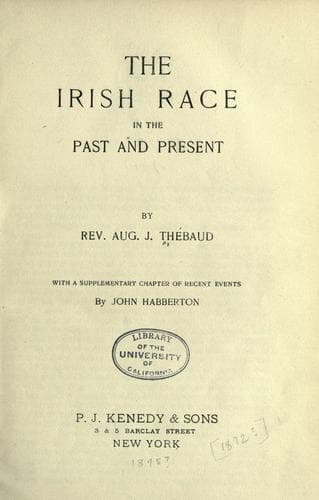
The Irish Race in the Past and the PresentThébaud, Augustus J.
History
The Irish Race in the Past and the Present
Thébaud, Augustus J.
Ireland -- History
With regard to the conversion of the Danes in Ireland, it seems
that, after all, it was the ever-present spectacle of the
workings of Christianity among the Irish which gradually opened
their eyes and ears. They came to love the country and the
people when they knew them thoroughly; they respected them for
their bravery, which they had proved a thousand times; they felt
attracted toward them on account of their geniality of
temperament and their warm social feelings; even their defects
of character and their impulsive nature were pleasing to them.
They soon sought their company and relationship; they began to
intermarry with them; and from this there was but a step to
embracing their religion.
The Danes of Waterford, Cork, and Limerick were, however, the
last to abandon paganism, and they seem not to have done so
until after Clontarf.
It is very remarkable that, during all those conflicts of the
Irish with the Danes, when the Northmen strewed the island with
dead and ruins; when they seemed to be planting their domination
in the Orkneys, the Hebrides, and even the Isle of Man, on a
firm footing; when the seas around England and Ireland swarmed
with pirates, and new expeditions started almost every spring
from the numerous harbors of the Baltic--the Irish colony of Dal
Riada in Scotland, which was literally surrounded by the
invaders, succeeded in wresting North Britain from the Picts,
drove them into the Lowlands, and so completely rooted them out,
that history never more speaks of them, so that to this day the
historical problem stands unsolved-- What became of the Picts?--
various as are the explanations given of their disappearance.
And, what is more remarkable still, is, that the Dal Riada
colony received constant help from their brothers in Erin, and
the first of the dynasty of Scottish kings, in the person of
Kenneth McAlpine, was actually set on the throne of Scotland by
the arms of the Irish warriors, who, not satisfied apparently
with their constant conflicts with the Danes on their own soil,
passed over the Eastern Sea to the neighboring coast of Great
Britain.
During the last forty years of the tenth century the Danes lived
in Ireland as though they belonged to the soil. If they waged
war against some provincial king, they became the allies of
others. When clan fought clan, Danes were often found on both
sides, or if on one only, they soon joined the other. They had
been brought to embrace the manners of the natives, and to adopt
many of their customs and habits. Yet there always remained a
lurking distrust, more or less marked, between the two races;
and it was clear that Ireland could never be said to have
escaped the danger of subjugation until the Scandinavian element
should be rendered powerless.
Public-domain text, read in full here on John Shaqi.
Reviews
Reviews
No reviews yet
Be the first to share your thoughts on this work.
Elsewhere in the archive
Join the Discussion
Join the discussion
Sign in to leave a comment or review.
Sign InorCreate an account