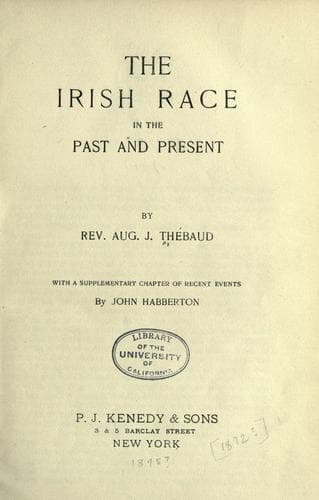
The Irish Race in the Past and the PresentThébaud, Augustus J.
History
The Irish Race in the Past and the Present
Thébaud, Augustus J.
Ireland -- History
The giver was considered the absolute owner of whatever he gave,
as is the commander of a vessel at sea. It was a beneficium
conferred by him, to which certain indispensable conditions were
attached. Military duty was the first, but not the only one of
these. Writers on feudalism mention a great number, the
nonfulfilment of which incurred what was called forfeiture.
In countries where the pirates succeeded in establishing
themselves, all the native population was either destroyed by
them, as Dudo tells us was the case in Normandy, or, as more
frequently happened, the sword being unable to carry destruction
so far, the inhabitants who survived were reduced to serfdom,
and compelled to till the soil for the conquerors; they were
thenceforth called villeins or ascripti glebae. It is clear that
such only as possessed land could claim civil and political
rights in the new states thus called into existence. Hence the
owning of land under feudal tenure was the great and only
essential characteristic of mediaeval feudalism.
This system, which was first introduced into Britain by the
Anglo-Saxons, was brought to a fixed and permanent state by the
Normans--followers of William the Conqueror; and, when the time
came for treachery to summon the Norman knights to Irish soil,
the devoted island found herself face to face with an iron
system which at that period crushed and weighed down all Europe.
The Normans had now been settled in England for a hundred years;
all the castles in the country were occupied by Norman lords;
all bishopries filled by Norman bishops; all monasteries ruled
by Norman abbots. At the head of the state stood the king, at
that time Henry II. Here, more than in any other country in
Europe, was the king the key-stone to the feudal masonry. Not an
inch of ground in England was owned save under his authority, as
enjoying the supremum dominium. All the land had been granted by
his predecessors as fiefs, with the right of reversion to the
crown by forfeiture in case of the violation of feudal
obligations. Here was no allodial property, no censitive
hereditary domain, as in the rest of, otherwise, feudal Europe.
All English lawyers were unanimous in the doctrine that the king
alone was the true master of the territory; that tenure under
him carried with it all the conditions of feudal tenure, and
that any deed or grant proceeding from his authority ought to be
so understood.
The south-western portion of Wales was occupied by Norman lords,
Flemings for the most part. Two of these, Robert Fitzstephens
and Maurice Fitzgerald, sailed to the aid of the Irish King of
Leinster. They were the first to land, arriving a full year
before Strongbow.
Public-domain text, read in full here on John Shaqi.
Reviews
Reviews
No reviews yet
Be the first to share your thoughts on this work.
Elsewhere in the archive
Join the Discussion
Join the discussion
Sign in to leave a comment or review.
Sign InorCreate an account