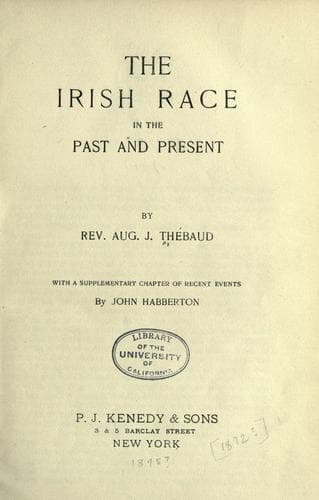
The Irish Race in the Past and the PresentThébaud, Augustus J.
History
The Irish Race in the Past and the Present
Thébaud, Augustus J.
Ireland -- History
A most important feature to be considered is their understanding
of property. Hereditary right of land with respect to
individuals, and the transmission of property of any kind by
right of primogeniture, were unknown among them. If a specified
amount of territory was assigned to the chieftain, a smaller
portion to the bishop, the shanachy, head poet, and other civil
officers each in his degree, such property was attached to the
office and not to the man who filled it, but passed to his
elected successor and not to his own children; while the great
bulk of the territory belonged to the clan in common. No one
possessed the right to alienate a single rood of it, and, if at
times a portion was granted to exiles, to strangers, to a
contiguous clan, the whole tribe was consulted on the subject.
Over the common land large herds of cattle roamed--the property
of individuals who could own nothing, except of a movable nature,
beyond their small wooden houses.
This state of things had existed, according to their annals, for
several thousand years. Their ancestors had lived happily under
such social conditions, which they wished to abide in and hand
down to their posterity.
Foreign trade was distasteful to them; in fact, they had no
inclination for commerce. Lucre they despised, scarcely knowing
the use of money, which had been lately introduced among them.
Yet, being refined in their tastes, fond of ornament, of wine at
their feasts, loving to adorn the persons of their wives and
daughters with silk and gems, they had allowed the Danes to
dwell in their seaports, to trade in those commodities, and to
import for their use what the land did not produce.
Those seaport towns had been fortified by the Northmen on their
first victories when they took possession of them. Throughout
the rest of the island, a fortress or a large town was not to be
seen. The people, being all agriculturists or graziers, loved to
dwell in the country; their houses were built of wattle and clay,
yet comfortable and orderly.
The mansions of the chieftains were neither large architectural
piles, nor frowning fortresses. They bore the name of raths when
used for dwellings; of duns when constructed with a view to
resisting an attack. In both cases, they were, in part under
ground, in part above; the whole circular in form, built
sometimes of large stones, oftener of walls of sodded clay.
Instead of covering their limbs with coats of mail, like the
warriors of mediaeval Europe, they wore woollen garments even in
war, and for ornaments chains or plates of precious metal. The
Norman invaders, clad in heavy mail, were surprised, therefore,
to find themselves face to face with men in their estimation
unprotected and naked. More astonished were they still at the
natural boldness and readiness of the Irish in speaking before
their chieftains and princes, not understanding that all were of
the same blood and cognizant of the fact.
Public-domain text, read in full here on John Shaqi.
Reviews
Reviews
No reviews yet
Be the first to share your thoughts on this work.
Elsewhere in the archive
Join the Discussion
Join the discussion
Sign in to leave a comment or review.
Sign InorCreate an account